


Last Updated: October 26, 2026
Quick Summary
Premium european garment hardware offers durability and aesthetic finish for lingerie, swimwear, and performance apparel. European-made components like Zamak metal sliders, rings, and hooks with electroplated finishes command higher retail prices while reducing recall risk through REACH compliance and skin-safe testing.
- XXL sliders in white bronze cost £4.00, rising to £7.00 for 24k gold plating
- Quality testing includes salt spray exposure, repeated fastening cycles, and tensile strength measurement
- Digital Product Passport requirements now mandate documentation of component sourcing, material composition, and testing data
- Premium suppliers with detailed batch records streamline EU audits; commodity suppliers often require expensive third-party testing
- Finish consistency is critical for premium positioning, requiring consistent plating color and tone across batches
Table of Contents
- What Premium European Garment Hardware Offers Manufacturers
- Metal Sliders and Rings: Core Hardware for Lingerie and Swimwear
- Hooks and Closures: Strength and Finish Options
- Garment Hardware Quality Testing and Durability Standards
- REACH-Compliant Garment Components: What Manufacturers Must Know
-
Garment Trim Supplier Checklist: How to Evaluate Your Options
- Build a side-by-side capability matrix
- Verify European origin and production capacity
- Get transparent procurement numbers before you commit
- Test the compliance paper trail
- Evaluate customization and finish consistency
- Check support responsiveness with a real question
- Red flags that should end the conversation
-
Sourcing Premium Hardware for Your Next Collection
- Write a hardware specification before you request samples
- Plan sampling, tooling, and MOQ around your launch volume
- Specify quality assurance and testing up front
- Address sustainability and material traceability
- Verify origin and capacity, then build redundancy
- Document everything for audit and recall defense
- Frequently Asked Questions
What Premium European Garment Hardware Offers Manufacturers
Premium european garment hardware offers durability and aesthetic finish for lingerie, swimwear, and performance apparel.
The EU textile and clothing sector faces real pressure. According to EURATEX's 2026 Facts & Key Figures, exports declined 2.9% and employment fell 2.8% in recent years. Yet within this challenging landscape, premium-positioned brands are gaining share by sourcing differentiated, skin-safe components that command higher retail prices and reduce recall risk.
At Allied Trimmings, we've supplied European-made hardware since 1981.
Metal Sliders and Rings: Core Hardware for Lingerie and Swimwear
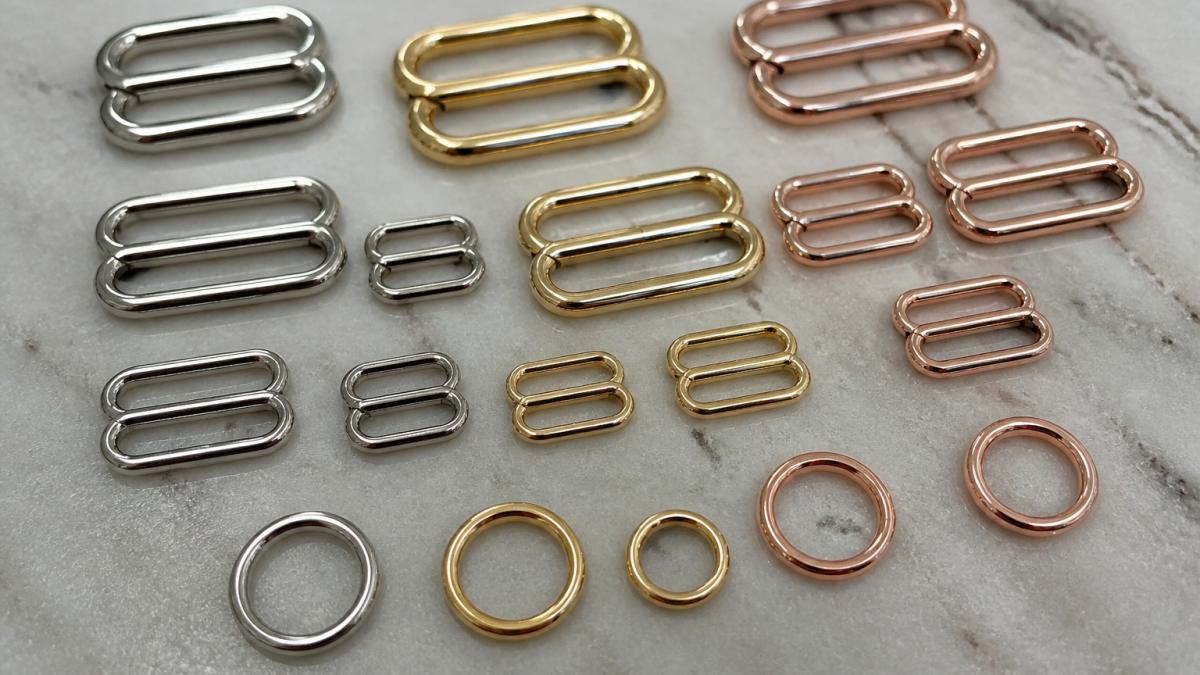
Metal sliders and rings are components used in adjustable intimates and performance wear. Explore the Lingerie Swimwear Collection to view the specialized hardware referenced throughout this article. Some listed products have Zamak alloy cores (zinc, magnesium, aluminum, copper) and electroplated finishes.
XXL sliders with 5mm tall openings are designed for double or extra-thick straps. Rectangular rings and sliders are available in listed sizes.
We offer Rings Sliders And Hooks in multiple finishes and sizes: XXL Sliders in white bronze are £4.00 (24k gold £7.00), and rectangular rings in white bronze are £2.00.
Our Rose Gold Zamak Metal Rings combo sets at £6.00 pair coordinated rings and sliders.
Hooks and Closures: Strength and Finish Options
Our 24kgold Zamak Metal Hooks are available in white bronze or 24k gold plating and seven size options for £3.00.

Garment Hardware Quality Testing and Durability Standards
Quality testing separates premium from commodity hardware. Real durability testing includes salt spray exposure, repeated fastening cycles, and tensile strength measurement. According to European Commission guidance on textile safety, manufacturers placing products on the EU market must ensure components meet REACH compliance for skin contact.
Allied Trimmings offers independently tested, skin-safe components. The product catalog identifies Oeko-Tex 100 certification for specific listed products.
REACH-Compliant Garment Components: What Manufacturers Must Know
Digital Product Passport requirements are emerging across the EU, requiring manufacturers to document component sourcing, material composition, and testing data per product. Premium suppliers with detailed batch records make audits straightforward; commodity suppliers often force expensive third-party testing before market entry.
Garment Trim Supplier Checklist: How to Evaluate Your Options
For manufacturers sourcing premium european garment hardware, a supplier checklist can cover claims, costs, and documentation.
Build a side-by-side capability matrix
Rather than evaluating suppliers one at a time, score every candidate on the same rows. A practical matrix can cover:
| Criterion | What to capture | Why it matters |
|---|---|---|
| Manufacturing location | Country and city of actual production, not just the sales office | European origin claims must be verifiable |
| Subcontracting | Whether any plating, casting, or finishing is outsourced | Subcontractors change compliance and lead-time risk |
| Product range | Sliders, rings, hooks, closures, and custom components offered | Fewer suppliers means more coordination overhead |
| Materials | Zamak, brass, steel, aluminum, and plating chemistry | Determines corrosion performance and REACH exposure |
| Customization | Custom plating colors, sizes, and finish tolerances | Premium positioning depends on finish consistency |
| Certifications | REACH, Oeko-Tex 100, GPSR statements, test reports | Compliance evidence, not marketing claims |
| MOQ | Stock-item and custom-finish minimums | Determines whether the supplier fits your volume |
| Lead time | Standard and rush capability, with historical data | Production planning risk |
| Documentation | Batch records, test certificates, traceability | Audit readiness and recall defense |
Score each supplier on the same scale and keep the matrix in your sourcing file as a reference for your selection.
Verify European origin and production capacity
"European" is a claim, not a fact. Ask where the metal is made and request information about its origin.
XXL Slider - White Bronze Plated Zamak Alloy - Tall Opening →
Get transparent procurement numbers before you commit
Ask each supplier to itemize:
- Sampling fees, whether they are credited against the bulk order.
- Tooling costs, for custom sizes, colors, or shapes, and whether the tooling is yours to keep.
- MOQ tiers, stock items versus custom finishes, and volume price steps.
- Lead times, standard, rush, and expedited premiums.
- Price drivers, metal content, plating chemistry, finish tolerance, and packaging.
Test the compliance paper trail
Check the available compliance information for the specific products you intend to order.
Evaluate customization and finish consistency
Premium positioning lives or dies on finish consistency. Ask how the supplier controls plating color and tone across a batch, what tolerances they hold, and whether they supply reference samples. If you need rose gold sliders in 8mm and 12mm, confirm both come from the same plating line, inconsistent tone is a common cause of returns in premium intimate apparel.
Check support responsiveness with a real question
Send a technical question, salt spray survival hours for a specific plating, or the tensile rating of a slider under strap load, and measure the response. Specific data within 24 hours demonstrates the engineering depth you will need during production; generic marketing language tells you something too.
Red flags that should end the conversation
- Compliance claims without product-specific certificates.
- No answer on where plating or casting takes place.
- Quoted lead times longer than 8 weeks with no rush option.
- MOQs that exceed your launch volume with no path to scale.
- Generic quality language ("high quality," "durable") with no test data.
- Slow or evasive responses to technical questions.
Sourcing Premium Hardware for Your Next Collection
Sourcing premium european garment hardware can involve specification and verification. Manufacturers may use a written spec and document their sourcing decisions.
Write a hardware specification before you request samples
A specification sheet can record product requirements. Capture:
- Component type and dimensions, slider opening height, ring inner diameter, hook size, with tolerances.
- Substrate, strap thickness and material the hardware will sit against, since this drives load and abrasion.
- Finish, plating color, tone, and sheen, with an approved reference sample.
- Attachment method, how the component is sewn, crimped, or attached, and the thread or tape used.
- Intended use, lingerie, swimwear, activewear, or outerwear, since chlorine, salt water, and laundering drive corrosion requirements.
- Performance requirements, minimum salt spray hours, fastening cycle count, and tensile load.
- Compliance requirements, REACH, Oeko-Tex 100, and GPSR documentation per batch.
Plan sampling, tooling, and MOQ around your launch volume
Build these numbers into your launch budget before you commit. A custom rose gold finish on a 500-unit launch may not be economical; a stock white bronze finish with a custom ring size might be. The supplier should be able to model both scenarios for you.
Specify quality assurance and testing up front
Quality claims are only useful if they are testable.
- Corrosion testing, salt spray hours with a stated pass threshold for your intended use.
- Abrasion and colorfastness, plating wear and color shift under repeated contact and laundering.
- Pull and tensile testing, the load at which sliders and rings deform, in kilograms.
- Fatigue testing, fastening cycle counts for hooks and closures.
- Inspection practice, AQL sampling level, visual criteria for plating defects, and batch record retention.
Address sustainability and material traceability
Premium buyers increasingly ask about recycled metal content, restricted-substance compliance, and traceability. Ask whether suppliers can document metal origin, whether recycled Zamak or brass is available, and how they track restricted substances through plating. If a supplier cannot trace a batch to its metal source, treat sustainability claims with caution.
Verify origin and capacity, then build redundancy
Confirm where casting, plating, and packing happen, and get that in writing. Ask for production capacity against your forecast and historical on-time delivery data. Then identify a secondary supplier for your highest-risk components, where a stockout would stop production. Redundancy costs little at the sampling stage and protects you when a primary supplier hits capacity or a compliance issue.
Document everything for audit and recall defense
Allied Trimmings has supplied European-made trimmings and components to designers and manufacturers in the lingerie, swimwear, and outdoor industries since 1981.
Frequently Asked Questions
What counts as premium European garment hardware?
Allied Trimmings supplies European-made trimmings and components for lingerie, swimwear, and outdoor industries. Listed products include Zamak alloy components with electroplated finishes, and specific products are identified as independently tested, skin-safe, and Oeko-Tex 100 certified.
How do manufacturers choose a reliable garment trim supplier?
When evaluating a garment trim supplier, review the available product information and ask about the supplier's history and the industries it serves. Allied Trimmings has supplied European-made trimmings and components since 1981 for lingerie, swimwear, and outdoor industries.
Why does REACH compliance matter for garment hardware?
Allied Trimmings describes its components as REACH and GPSR ready for supply chains and offers independently tested, skin-safe components. Check the compliance information for the specific product you are considering.
What's the difference between standard and XXL slider hardware for garment manufacturing?
The catalog lists sliders in sizes from 6mm to 25mm and XXL sliders with a 5mm tall opening designed for double or extra-thick straps. The listed XXL sliders are made in France with Zamak cores and are available in white bronze for £4.00, 24k gold for £7.00, and .925 silver for £4.00.
How can small apparel startups work with premium European hardware suppliers?
Allied Trimmings serves designers and manufacturers in the lingerie, swimwear, and outdoor industries. Its listed products include bulk-packed manufacturing components and products sold in specified pack quantities. Contact the supplier to discuss your requirements.
Sourcing the right garment hardware is one of the highest-ROI decisions you'll make as a manufacturer. Premium components reduce recall risk, extend product life, and justify higher retail pricing. Choose options that combine compliance verification, proven durability testing, and responsive customer support. Get started with Allied Trimmings and access European-made hardware engineered for brands that demand quality.


