


Last Updated: October 25, 2026
Quick Summary
Skin-safe metal for lingerie is worth specifying because metal hardware sits against skin all day, and nickel release from worn coatings causes itching, redness and rashes. Specify coated steel with named composition, Oeko-Tex Standard 100 certification and current nickel release test reports naming the exact component and size.
- A nickel allergy in bras is allergic contact dermatitis, a delayed reaction appearing hours after wear.
- Hooks and eyes carry the highest-friction metal contact, so coating wears at the hook lip and eye loop first.
- Sliders usually reveal coating failure first because they move constantly on the strap.
- Ask for release data on the finished component, not the raw material before coating.
- Hand washing and air drying extend the life of the coating barrier against skin.
Table of Contents
- Why Skin-Safe Metal Components for Lingerie Decide Comfort
- Nickel Allergy in Bras: What the Reaction Actually Is
- Where Metal Sits Against Skin: Hooks, Sliders, Rings and Underwires
- Nickel-Free Bra Hardware: What to Look For and What to Avoid
- Nickel Release Testing for Clothing Components, Explained
- REACH-Compliant Apparel Hardware and How to Verify a Claim
- Coatings, Plating and Wear: How Hardware Ages Against Skin
- Choosing Your Next Hardware Order
- Frequently Asked Questions
Why Skin-Safe Metal Components for Lingerie Decide Comfort
A bra strap can fit perfectly and still ruin a wearer's afternoon. The culprit is often the smallest part of the garment: the metal that touches skin all day.
A garment can pass every fit test and still fail the wear test. Metal sits against the body at the strap, under the bust, and along the back closure. When it releases nickel or loses its coating, the result is itching, redness, and a rash customers blame on the bra as a whole.
Nickel Allergy in Bras: What the Reaction Actually Is
A nickel allergy in bras is an allergic contact dermatitis: the immune system reacts to nickel ions released from metal that sits against skin. It is a delayed reaction, so the rash often appears hours after putting the garment on.
That delay is why so many cases get misdiagnosed. A wearer might blame washing powder, heat, or a new fabric when the real trigger is the hook at her back.
Symptoms: Itching, Redness, Rash and Welts
The signs follow a pattern: itching first, then redness along the line where metal contacts skin. A raised rash or small welts can follow, and longer exposures may crack or weep. Symptoms concentrate exactly where hardware touches the body: under the arms, across the back closure, and beneath underwires.
Allergy, Irritation or Something Else?
Not every reaction is an allergy. Irritation is a direct physical response to friction, sweat, or a rough edge, and clears once the trigger is removed. Allergic contact dermatitis is immune-mediated and can worsen with repeated exposure.
Distinguishing them matters because the fix differs. If the rash tracks the exact shape of a hook or ring, suspect the metal. If it follows a seam or elastic band, look at fabric and fit first.
Where Metal Sits Against Skin: Hooks, Sliders, Rings and Underwires
Lingerie hardware is not one material problem but four. Each component has a different job, wear pattern, and level of skin contact. A hook that presses against the spine for ten hours behaves nothing like a slider that moves a hundred times a day.
Use this comparison of the main hardware positions, by material, skin-contact risk, and alternatives, as a specification checklist.
Hooks and Eyes: Highest Friction, Highest Consequence
The back closure presses against the spine, takes repeated tension during fastening, and sits under the weight of the band, the highest-friction metal contact point on most bras.
- Common materials: Nylon-coated steel, painted steel, Zamak alloy, and occasionally plastic.
- Skin-contact risk: High. Coating wear at the hook lip and eye loop exposes base metal first.
- Practical alternatives: Nylon-coated steel in a matched coating family; plastic hooks for light-support styles; fabric-covered closures for sleep and lounge bras.
Sliders: Where Coating Wear Shows Up First
Strap adjusters sit on the shoulder or upper back and move constantly. If a coating system will fail, the slider usually tells you first.
- Common materials: Nylon-coated steel, electroplated steel, and molded plastic.
- Skin-contact risk: High on moving straps; lower on static decorative straps.
- Practical alternatives: Nylon-coated steel for adjustable styles; plastic sliders for light garments; metal-free adjusters where strap tension is low.
Rings: Load-Bearing Connectors
Strap-to-cup connectors carry load and rub against strap and fabric in a high-movement zone.
- Common materials: Nylon-coated steel, electroplated steel, plastic, and wood or resin for decorative trims.
- Skin-contact risk: Moderate to high depending on ring diameter and strap tension.
- Practical alternatives: Nylon-coated steel in the same coating family as hooks and sliders; plastic rings for light-support bralettes; fabric-covered rings for sensitive-skin collections.
Underwires: The Longest Metal Run
The underwire is the longest continuous metal run in the garment, sitting under the bust where sweat accumulates. It is also the component most often blamed for a rash that actually starts at the closure.
- Common materials: Nylon-coated steel, plastic, and wrapped wire.
- Skin-contact risk: High where the wire tip or casing wears through; lower when the wire stays fully encased.
- Practical alternatives: Coated steel underwires with reinforced tips; plastic underwires for light support; wire-free construction for sensitive-skin styles.
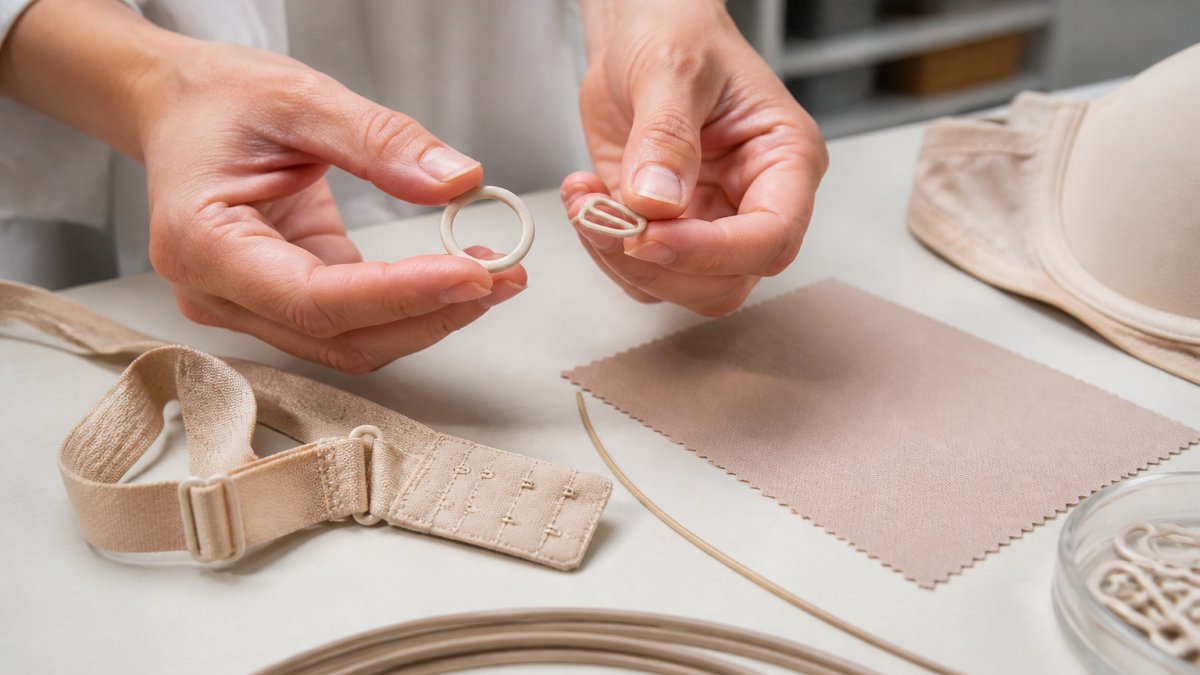
For the hook position, our white nylon coated steel hooks are dyeable and available in ten sizes, letting a design team match color without switching suppliers. The white dyeable nylon coated steel rings cover 6mm to 25mm, and the white nylon coated steel sliders handle strap adjustment in the same coating system. Keeping all three in one coating family simplifies color matching and compliance paperwork.


Nickel-Free Bra Hardware: What to Look For and What to Avoid
Nickel-free bra hardware is hardware where nickel is not used in the base metal or the surface finish.
Avoid uncoated base metal, decorative plating of unknown composition, hardware described only as "metal" with no alloy stated, and any supplier who cannot tell you what the coating is.
What to look for instead:
- A named base material, such as nylon-coated steel or Zamak alloy
- An explicit statement that the component is lead-free and nickel-free
- A certification you can check, such as Oeko-Tex Standard 100 (OEKO-TEX® STANDARD 100)
One caution worth repeating: a component described as nickel-free may still not suit every person with nickel sensitivity.
Nickel Release Testing for Clothing Components, Explained
Nickel release testing measures how much nickel migrates from a component onto skin under simulated wear conditions, different from testing whether nickel is present at all.
The distinction matters. A component can contain nickel and release almost none if properly coated, or be labeled nickel-free and still cause problems if the coating fails in wear.
Research into skin-contact clothing supports the concern. A study in the Textile Research Journal on trace elements in skin-contact clothes examined how metals used as dyes, pigments, mordants, and catalysts can migrate to artificial sweat.
Ring - Beige Nylon Coated Steel Rings (10, 12, 16mm) Pantone 14-1212 Frappe. →
Ask suppliers for release data on the finished component, not the raw material.
REACH-Compliant Apparel Hardware and How to Verify a Claim
REACH-compliant apparel hardware meets the European Union's regulation on chemicals, which restricts substances of concern in articles sold in the EU. For lingerie hardware, the relevant concerns are nickel release and restricted substances in coatings and finishes.
Verification is where most sourcing conversations fall apart. A supplier saying "REACH compliant" in an email is not evidence. How to check it:
- Request the test report, not a certificate of compliance alone
- Confirm the report names the exact component and size you are ordering
- Check the testing lab is independent of the manufacturer
Watch out: a report covering a different size or colorway than the one you order is a common gap. Coatings and alloys can change between production runs, so a report from two years ago may not describe what ships today.
Coatings, Plating and Wear: How Hardware Ages Against Skin
A coating is a barrier, and barriers degrade. Nylon coating on steel protects the skin from the metal beneath, but friction, sweat, salt water, and repeated laundering work against it. The useful question is not whether a coating will wear but where it will fail first and how you will know.
The Mechanisms That Break a Barrier
Coating wear follows a predictable sequence:
- Friction: Moving parts such as sliders and strap rings abrade the coating at the contact edge. Repeated adjustment cycles thin the barrier in one spot.
- Sweat and salt: Perspiration is mildly acidic and contains salts. Over time it can attack coating adhesion, especially at edges where the coating meets bare metal.
- Laundering: Detergents, heat, and mechanical action in a washing machine accelerate coating wear. Hand washing and air drying extend barrier life.
The barrier typically fails at edges and flex points first, not across the flat surface. That is why inspection should focus on lips, tips, and channels rather than the visible face of the component.
Where Wear Shows Up First
Wear is predictable by position:
- Sliders on moving straps lose coating at the internal channel and outer edges.
- Hooks under tension wear at the hook lip and the eye loop.
- Underwire tips rub against casing and are often the first place a barrier is compromised.
Once the barrier is compromised, the metal underneath is exposed to skin, the point at which a component that passed a release test at production can start to behave differently in wear.
Coated Metal Versus Decorative Plating
This is the argument for coated metal over decorative plating in high-wear positions. Electroplated finishes look better on a sample card, but plating can be thin and wear through at contact points.
Plating is not inherently unsafe, but it demands more verification. If a supplier proposes a plated component for a high-friction position, ask for coating thickness data and wear-test results on the finished part, not the raw substrate.
Inspection and Replacement Guidance
A practical inspection routine for sensitive-skin garments:
- Check hook lips and eye loops for exposed base metal or flaking
- Run a fingertip through slider channels for burrs or coating gaps
- Inspect underwire tips for coating coverage and casing wear
For brands, this translates into care instructions and, where appropriate, a replacement-parts policy. Telling customers to hand wash and air dry extends the life of the barrier that keeps metal off skin.
Choosing Your Next Hardware Order
The right order balances material safety, durability in the actual wear environment, and documentation you can defend if a customer complains.
| Decision | What to Specify | Why It Matters |
|---|---|---|
| Base material | Coated steel or alloy with named composition | Predictable skin contact and wear behavior |
| Coating | Nylon coating for high-friction points | Thicker barrier than thin plating |
| Certification | Oeko-Tex Standard 100 plus test report | Verifiable, not just claimed |
| Component family | One coating system across hooks, rings, sliders | Consistent color and simpler compliance |
| Documentation | Current report naming exact component and size | Defensible if a claim is challenged |
If you are still mapping out component choices, our guide on how to choose durable apparel hardware components walks through the selection criteria in more detail. Before you place a first order, it also helps to read up on how to find reliable garment trim suppliers, since vetting the supplier is as important as vetting the part.
At Allied Trimmings, we have supplied European-made, independently tested trimmings since 1981, and our components are built to meet REACH and GPSR requirements for lingerie, swimwear, and outdoor supply chains. Our nylon-coated steel hooks, rings, and sliders are Oeko-Tex 100 certified, lead-free, and nickel-free, with bulk packaging suited to production volumes.
Frequently Asked Questions
What metals are safest for sensitive skin in lingerie?
Coated steel and plated Zamak alloy are the practical choices when the metal is fully covered. Nylon-coated steel rings, sliders and hooks keep the base metal away from skin contact, and Oeko-Tex 100 certification confirms the component has been checked for harmful substances. Plated Zamak, such as white bronze electroplating over a Zamak core, gives a jewelry-quality finish for thicker straps. A brand's GPSR guidance notes that even nickel-free or trace-amount components may not suit every person with severe nickel sensitivity, so patch testing a finished garment is still sensible.
Can nickel in bra hardware cause a skin reaction?
Yes. Nickel is a common cause of allergic contact dermatitis, and bra hooks, sliders, rings and underwire ends sit against skin that sweats and flexes all day. Reactions typically show as itching, redness, a rash or welts under the strap line or at the centre back. If a reaction clears when you switch garments and returns with the same bra, the hardware is the first thing to inspect.
How can I tell whether lingerie hardware is nickel-free?
Ask for the certification, not the marketing word. A genuine nickel-free bra hardware claim should come with a named test standard and a certificate you can read, such as an Oeko-Tex 100 certificate covering the specific component. Check that the certificate matches the article number, colour and finish you are ordering, because a certificate for a different plating does not transfer. Allied Trimmings lists its nylon-coated steel rings, sliders and hooks as 100% lead-free and 100% nickel-free, Oeko-Tex 100 certified and made in France, so the paperwork trail is traceable to a specific product.
What does nickel release testing mean for clothing components?
Nickel release testing measures how much nickel migrates out of a metal part onto skin or artificial sweat over a set period, rather than simply confirming nickel is present in the alloy. For lingerie, release testing matters more than a materials list because a coated or plated part can still release metal once the coating wears through at a friction point.
Are stainless steel components suitable for lingerie?
Stainless steel is durable and resists corrosion, which suits swimwear and activewear straps that meet salt water and sweat. The caveat is nickel: many stainless grades contain it, so a steel part is not automatically nickel-free. For sensitive-skin lingerie, a coated steel component, such as nylon-coated steel rings and sliders, adds a barrier between the alloy and skin while keeping the strength of steel. Confirm the coating spec and the certification before specifying it for a sensitive-skin line.
The hardest part of sourcing skin-safe hardware is not finding a coated hook. It is proving, order after order, that the component on the line matches the report in the file. That is the gap we built our business around: independently tested, European-made components with documentation that holds up. Get started with Allied Trimmings and specify hardware you can defend to your customers.


