


Last Updated: November 12, 2026
Quick Summary
Apparel hardware is the hooks, sliders, rings and closures that touch skin and take strain in a garment, and jewelry-quality components use a stable metal core with a durable electroplated finish. For lingerie, swimwear and outdoor gear, choose hardware that is skin-safe, resists salt and friction, and is tested on the garment before a bulk order.
- Choose hardware by strap width, load and finish before comparing unit prices.
- Test samples on the actual garment, then put them through the wash or exposure cycle.
- Compare suppliers on total landed cost per usable piece, not unit price alone.
- Ask for the test report behind any nickel-free or Oeko-Tex claim before relying on it.
Table of Contents
- How to Choose Durable Lingerie Hardware Without Sacrificing Comfort
- Swimwear Hardware Components That Hold Up to Salt Water and Friction
- Skin-Safe Apparel Hardware: What Nickel-Free, Oeko-Tex and EU Compliance Mean
- Outdoor Gear Hardware: Hooks, Rings and Wire for Demanding Use
- Comparing Wholesale Options: Minimums, Samples and Total Landed Cost
- Choosing Your Next Hardware Order for Your Line
- Frequently Asked Questions
Allied Trimmings has supplied European-made trimmings to lingerie, swimwear and outdoor designers since 1981, and hardware is where a garment's quality is most often tested. The global jewelry market is projected to reach $397.7 billion in 2026 (Grand View Research jewelry market size report), and the same finishing standards that make jewelry sell are increasingly being asked of the hooks, sliders and rings inside a garment.
Apparel hardware is the part of a garment that touches skin, takes the strain and gets washed the most. A plating that flakes or a core that corrodes shows up as a return, a complaint or a recall. Jewelry-quality components, meaning zamak or steel cores with stable electroplated finishes, are built to hold their shape and finish through repeated use.
Two pressures make this more urgent. Lingerie and swimwear sit against skin for hours, so compliance matters as much as appearance. Outdoor gear adds salt, UV and constant friction. A closure that performs in a showroom can fail on a beach or a trail.
How to Choose Durable Lingerie Hardware Without Sacrificing Comfort
Durable lingerie hardware balances three things: a stable metal core, a finish that resists wear, and a size that suits the strap or band it closes. Start with the strap width and the load the closure will carry, then choose the finish and the nickel content. A smaller, well-plated component often outlasts a larger one with a thin coating.
Comfort depends on smooth edges and correct sizing. A slider that sits flat against the strap rubs less than one that pinches. Test samples on the garment itself, not on a flat surface, before committing to a full run.
Bra Hooks and Closures in White Bronze and 24k Gold
Hooks are where most bra closures succeed or fail, and the finish is the first decision. Allied Trimmings offers [PRODUCT_LINK: white bronze hooks | page:1] in sizes from 8mm to 25mm, with a Zamak core and a radiant white bronze plating. For a warmer tone, the [PRODUCT_LINK: 24k gold plated hooks | page:3] in 5mm to 25mm give the same core construction in gold. Both are made in France.
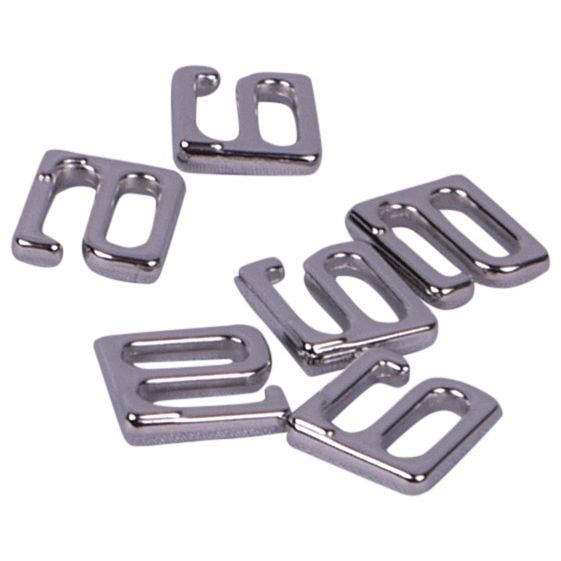
Choose white bronze for a silver-toned line and gold for a premium look. Match the hook width to the band elastic so the closure does not pull the fabric.
Sliders and Rings for Adjustable Straps
Adjustable straps need sliders that hold position without slipping. For standard straps, [PRODUCT_LINK: white bronze sliders | page:2] in 6mm to 25mm offer a smooth finish suited to lingerie and swimwear. For thicker straps, the [PRODUCT_LINK: XXL tall-opening slider | page:5] is designed for double or extra thick straps, with a 5mm tall opening.
Rings complete the adjustment system. Pair them with the slider width so the strap moves freely without stretching.
Swimwear Hardware Components That Hold Up to Salt Water and Friction
Swimwear hardware faces chlorine, salt and constant wet friction. Plating adhesion is the main concern: a finish that bonds well to the core resists the abrasion that wears through thinner coatings. Rectangular rings in .925 matte silver suit swimwear straps.
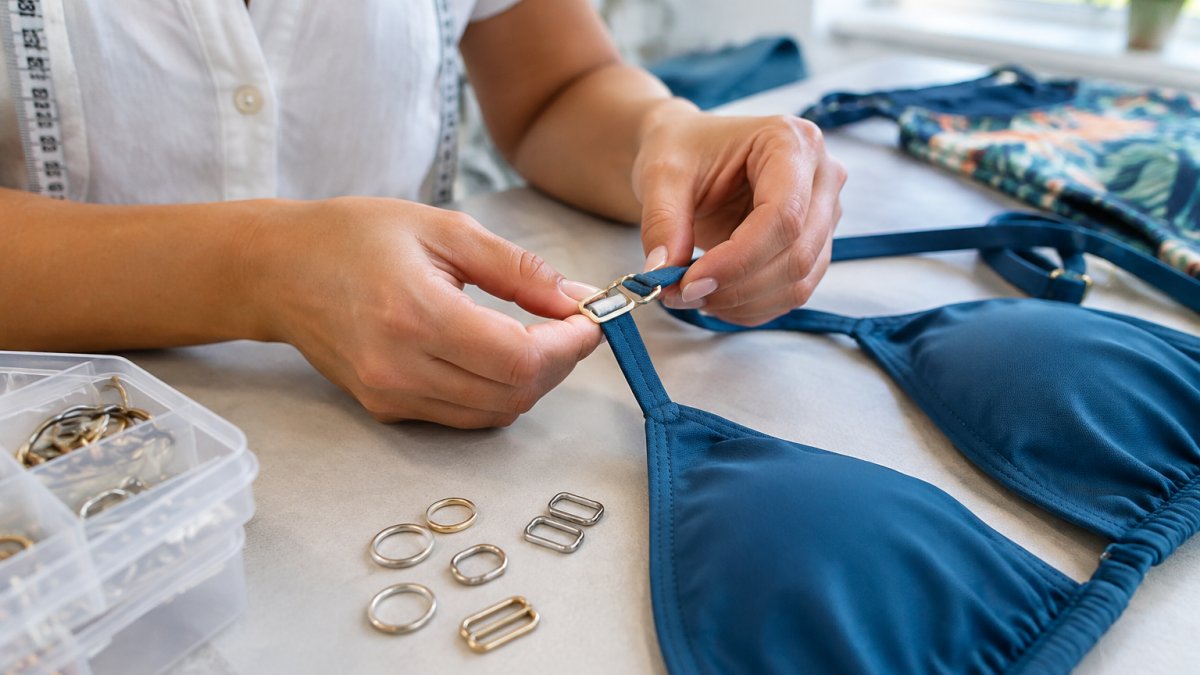
Test any component in the water you expect the garment to see, then check it after repeated wash cycles.
Skin-Safe Apparel Hardware: What Nickel-Free, Oeko-Tex and EU Compliance Mean
Skin-safe hardware should carry a formal standard behind the label. Ask a supplier for the test report, not just the claim.
Check which EU regulation applies to your market before you rely on any skin-safety claim.
Outdoor Gear Hardware: Hooks, Rings and Wire for Demanding Use
Outdoor gear needs hardware that survives UV, salt and abrasion. Nylon-coated steel hooks resist corrosion and can be dyed to match the fabric. The [PRODUCT_LINK: dyeable white nylon-coated steel hook | page:8] comes in ten sizes from 8mm to 25mm, and the [PRODUCT_LINK: black nylon-coated steel hook | page:9] suits darker technical fabrics.
For structural wire, a [PRODUCT_LINK: nylon-coated monowire underwire | page:10] with Rilsan-tipped ends prevents fraying during high-volume assembly.
Comparing Wholesale Options: Minimums, Samples and Total Landed Cost
Unit price is the least reliable number on a wholesale quote. The figure that decides whether a hardware order makes or loses money is total landed cost per usable piece, and it is built from five line items: the ex-works unit price, the freight and duty to your facility, the cost of samples and rejected components, the carrying cost of inventory you cannot sell through, and the labor cost of sorting or reworking a bad batch. A hook quoted at a lower unit price but sold only in large minimums can cost more per garment than a slightly dearer hook available in small quantities, because unsold stock and write-offs are real costs.
Order minimums work differently by buyer type, so ask any supplier about its minimum-order terms before you commit. Ask whether mixed-color or mixed-size minimums are allowed rather than per-SKU minimums, and how repeat orders and color continuity are handled across a production run.
Samples are where most sourcing mistakes are caught cheaply. Request samples in the exact finish, size and core material you plan to produce, not a stock photo or a different plating. Test each sample on the actual garment, on the strap, band or panel it will close, and put it through the wash or exposure cycle the finished product will see. A common pattern is that a component passes a flat-surface pull test but fails once it is sewn into a curved seam under load.
Freight and duty change the total cost more than most buyers expect. If you import, confirm who pays duty and what documentation the supplier provides for your customs broker. Volume discounts are worth negotiating only after you know your true annual usage per SKU, a discount on a size you use twice a year is not a saving.
A practical comparison method is to build a one-page cost sheet per candidate supplier covering unit price, minimum order quantity, sample cost and lead time, freight and duty estimate, and the compliance documents included. Score each supplier on those five lines rather than on unit price alone, and re-score after you have tested samples on the garment. That sheet is also the fastest way to see which supplier suits your buyer type, a low-minimum, sample-friendly supplier for a new line, or a high-volume, documentation-heavy supplier for a production program.
The five line items that make up total landed cost per usable piece, as described in the article:
| Cost item | What it covers | Why it matters |
|---|---|---|
| Ex-works unit price | The quoted price per component | Only one part of the true cost |
| Freight and duty | Delivery to your facility, including import duty | Can change total cost more than buyers expect |
| Samples and rejects | Testing samples and rejected components | Cheap to catch mistakes early |
| Inventory carrying cost | Stock you cannot sell through | Unsold stock is a real cost |
| Sorting and rework labor | Sorting or reworking a bad batch | Adds cost on top of the purchase price |
Choosing Your Next Hardware Order for Your Line
Start with the garment, then match the hardware to its load, its exposure and its compliance requirements. Lingerie needs skin-safe, comfortable closures. Swimwear needs finishes that survive salt and friction. Outdoor gear needs corrosion resistance and reliable dyeing. But the same ordering logic applies to the apparel hardware that sits outside the jewelry-and-trims catalog most buyers start with: buttons, snaps, zippers, buckles and rivets.
Apparel garment hardware is chosen by function first. For each of these, ask the same three questions you would ask of a jewelry finding: what is the core material, what is the finish and how is it bonded, and what test documentation covers skin contact and durability.
Segment the order by buyer type. Independent designers and craft businesses should start with low minimums and mixed-size samples across a few finishes, then reorder only the SKUs that pass garment testing. Apparel manufacturers should lock finish batches and dye lots before a production run and confirm lead times against the sewing schedule. Larger retailers and brands should request compliance files and batch traceability up front, because a recall or a skin-reaction complaint costs far more than the hardware.
Quality verification is the step most buyers skip. Ask for the material composition of the core, the plating type and thickness range, and any test reports for nickel release or harmful substances. Compare a sample against the production batch, color, weight and edge smoothness are quick checks, and keep a retained sample so you have a physical reference for the next order.
Watch out: mixing hardware from several suppliers on one garment can create a finish mismatch that shows under store lighting, and it splits responsibility if a closure fails.
Allied Trimmings supplies European-made trimmings for lingerie, swimwear and outdoor apparel, so you can test and reorder consistently across your range. Build your cost sheet, test samples on the garment, confirm the documentation, and then place the bulk order, in that order.
Frequently Asked Questions
Where can apparel designers buy jewelry-quality hardware wholesale?
Look for suppliers that sell hooks, sliders, rings and wire by the bulk pack rather than by the single piece, and that publish their materials and plating. Allied Trimmings, founded in 1981, supplies European-made trimmings for lingerie, swimwear and outdoor apparel. Compare the price of each item against your order volume, and request samples of the plating finish before committing to a full run so you can check colour and feel on your own fabric.
How do you choose durable hardware for lingerie and swimwear?
Start with the core material and the plating. Zamak alloy cores finished with electroplating, such as White Bronze or 24k Gold, give a polished look and a sturdy base for bra hooks, sliders and rings. For swimwear, choose a size that matches your strap width, since oversized components can rub and stress thin elastic. Confirm the product is nickel-free if it will sit against skin, and ask for the tall-opening XXL sliders when straps are doubled or thick.
What materials are best for apparel hardware that contacts skin?
For hardware that touches skin, prioritise nickel-free and lead-free components. Allied Trimmings lists lead-free, nickel-free and Oeko-Tex 100 certification for several of its zamak items, including the sliders and rectangular rings, and states that these meet EU safety standards for skin-contact garments. Nylon-coated steel hooks are another option for closures, since the coating keeps metal away from the wearer. Always check the certification on the product listing before you specify it.
What does REACH compliance mean for apparel hardware?
REACH is an EU regulation on chemical substances in products sold in the European Union. For apparel hardware, it means the supplier can document compliance with the regulation. Allied Trimmings states that its components are built to meet REACH and GPSR requirements for supply-chain use. Ask any supplier for their compliance documentation before you approve a bulk order for production.


