


Last Updated: October 23, 2026
Quick Summary
To avoid garment component recalls, conduct design reviews and risk assessments before sourcing, implement component safety testing matched to your market's standards, verify supplier quality assurance, use a role-based compliance checklist, establish batch traceability, and plan your recall response before you need it.
- Design reviews identify hazards early when changes are cheapest, evaluating skin contact, age groups, stress points, and environmental exposure.
- A component-hazard test matrix links each component to its failure modes and required tests, with sampling frequency and acceptance criteria.
- Different markets impose different requirements: US children's apparel faces small-parts rules and flammability standards; EU requires REACH compliance and EN 14682 for drawstrings.
- Retesting is triggered by change, new supplier materials, design changes, facility moves, or quality issues, not by calendar alone.
- Traceability systems must link component batches to purchase orders and production runs so you can instantly identify affected products when a supplier issues a recall.
Table of Contents
- Why Garment Component Recalls Happen
- Step 1: Conduct a Design Review and Risk Assessment
- Step 2: Implement Garment Component Safety Testing
- Step 3: Verify Supplier Quality Assurance for Apparel
- Step 4: Build a Garment Hardware Compliance Checklist
- Step 5: Establish Garment Component Traceability
- Step 6: Plan Your Recall Response and Corrective Action
- Frequently Asked Questions
Why Garment Component Recalls Happen
Garment component recalls occur when hardware, fasteners, or materials fail safety standards or pose a consumer risk, driven by design oversights, supplier quality issues, inadequate testing, or undocumented component changes.
Recalls damage brand reputation, drain resources, and expose your business to regulatory action and liability, which is why you must avoid garment component recalls through rigorous prevention systems.
Allied Trimmings has worked with apparel makers since 1981, supporting brands in preventing recalls through strong systems and processes.
Step 1: Conduct a Design Review and Risk Assessment
Start before you source a single component. A design review identifies hazards early, when changes are cheapest.
Evaluate your garment for potential risks. Ask these questions:
- Which components contact skin directly?
- What age groups will wear this garment?
- What stress points exist in seams, closures, and edges?
Document findings in a simple risk matrix: each component, its hazard level, and the consequence if it fails. High-risk items (like closures on children's sleepwear) need stricter controls.
Involve your production team and suppliers, they catch design issues your team might miss. A quick design conversation now prevents expensive recalls later.
Step 2: Implement Garment Component Safety Testing
Testing proves your components meet safety standards before they reach customers. Without independent testing, you're guessing whether your hardware is safe. A risk-based protocol links each component hazard to the right test, sampling frequency, acceptance criteria, and retesting trigger.
Build a component-hazard test matrix
Start by mapping every component to its failure modes and the tests that address them. The matrix below covers common garment component hazards. Use it as a starting point and adapt it to your product type and market.
| Component | Hazard | Typical tests | Sampling frequency | Acceptance criteria | Retest trigger |
|---|---|---|---|---|---|
| Metal snaps, buttons, zippers | Nickel release, corrosion, sharp edges | Nickel release (EN 1811 / EN 12472), salt spray corrosion, sharp edge inspection | Every batch or per supplier certificate | Nickel release below migration limit; no sharp edges; corrosion within agreed rating | New supplier, new alloy, new plating process |
| Small plastic buttons, beads, decorative trims | Choking hazard (small parts) | Small parts cylinder test (16 CFR 1501 for US children's items), tension/pull test | Every production run for children's items | No component detaches under specified force; fits small parts cylinder | Design change, new attachment method, new supplier |
| Drawstrings and cords | Strangulation, entanglement | Drawstring length and toggle tests per applicable standard (e.g., EN 14682 for children's clothing) | Every style and size range | Cord length and free ends within standard limits; no toggles on hood cords | Pattern change, new trim supplier |
| Elastic and straps | Tensile failure, snap-back | Tensile strength, elongation, fatigue cycling | Per batch or per supplier certificate | Meets specified minimum tensile strength and elongation | Material change, new supplier, process change |
| Labels and heat transfers | Skin irritation, detachment | Adhesion/peel test, fiber content and care label verification, pH and formaldehyde where applicable | Per production run | Label remains attached after specified wash cycles; fiber content accurate | New label supplier, new adhesive, new fabric |
| Coatings, prints, and finishes | Chemical migration, flammability | Heavy metals (lead, cadmium), phthalates, formaldehyde, azo dyes, flammability where required | Per batch or per supplier certificate | Within regulatory limits for target market | New ink, new coating, new fabric base |
| Children's sleepwear components | Flammability, small parts, cords | Flammability testing per 16 CFR 1615/1616 (US) or equivalent, small parts, cord tests | Every production run | Meets flammability standard; no small parts; cords compliant | Any design, fabric, or component change |
The matrix isn't exhaustive, but it forces the question: for each component, what could go wrong, and what test proves it won't? Document the answers in your component specification.
Match tests to market and product type
Different markets impose different requirements. A component that passes one market's tests may fail another's:
- United States: Children's apparel faces small-parts rules (16 CFR 1501), flammability standards for children's sleepwear (16 CFR 1615/1616), and CPSIA requirements including lead and phthalate limits. General apparel also falls under flammability rules (16 CFR 1610).
- European Union: REACH restricts chemicals including azo dyes, nickel release, and certain phthalates. EN 14682 addresses drawstrings on children's clothing (British Standards Institution). GPSR (General Product Safety Regulation) places obligations on producers and importers.
- Other markets: Many countries reference ISO or national standards for nickel release, small parts, and flammability. Confirm requirements with your testing lab or regulatory advisor before production.
Don't assume a supplier's test report covers your market. Check the standard cited, the test method, the lab's accreditation, and the date. A nickel release report under one method may not satisfy a buyer expecting another.
Set sampling frequency and acceptance criteria
Sampling frequency should reflect risk. High-risk components, closures on children's items, skin-contact metals, small detachable parts, warrant every-batch testing or supplier certificates backed by periodic independent verification. Lower-risk components may need only annual verification if the supplier's process is stable and documented.
Write acceptance criteria into your component specification before you order. "Meets safety standards" is not a criterion. Specify the standard, test method, limit, and sampling plan.
Know when to retest
Retesting is triggered by change, not by calendar alone. Retest when:
- A supplier changes material source, alloy, plating, adhesive, or manufacturing process.
- You change component design, attachment method, or garment construction.
- A supplier moves production to a different facility.
Keep all test reports on file, linked to the component specification and production batch. They document due diligence if a question arises.
Step 3: Verify Supplier Quality Assurance for Apparel
Your suppliers are responsible for the quality of what they send you. But verification is your responsibility. Weak supplier controls create weak garment component safety.
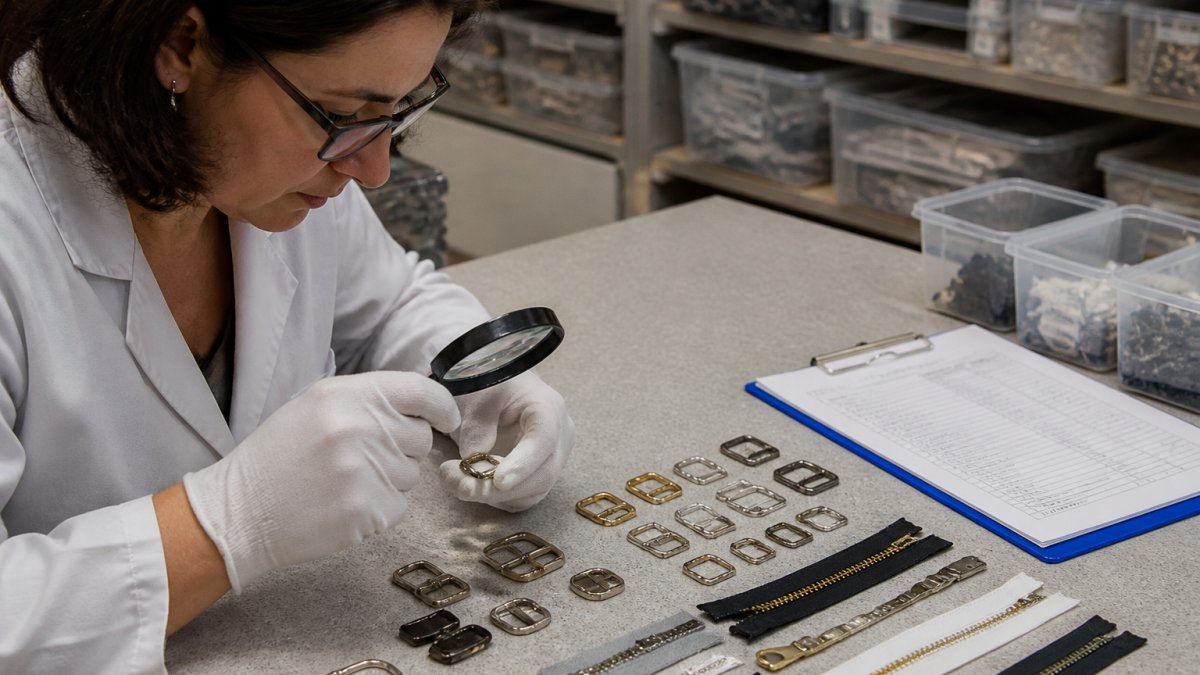
Auditing supplier processes
Visit your supplier's facility or request documented evidence of their quality systems. Ask what incoming inspection they perform on raw materials, how they handle component defects, and what happens when they detect a problem.
A good supplier has written procedures, tracks batches, keeps records, and can tell you exactly which production run a component came from.
Requesting compliance documentation
Ask your supplier for:
- Test reports for the components they supply
- Material safety data sheets (MSDS) for any chemicals used
- Documentation of their quality control procedures
Allied Trimmings provides full compliance documentation and independently tested, skin-safe components, demonstrating a commitment to safety.
Step 4: Build a Garment Hardware Compliance Checklist
A checklist ensures nothing slips through, use it for every style, production run, and supplier change. A role-based checklist assigns ownership, ties each item to a component hazard, and links to the records that prove the item was done.
Role-based prevention checklist for apparel teams
The checklist below assigns each action to the team most likely to own it. Adapt the roles to your organization. The point is that every item has an owner and a record.
| Stage | Checklist item | Owner | Record to keep |
|---|---|---|---|
| Design | Design review completed; components listed with intended function and skin-contact status | Design | Design review form; component list |
| Design | Risk assessment completed; each component mapped to hazard and risk level | Design / Quality | Risk matrix |
| Design | Children's product determination made; applicable small-parts, drawstring, and flammability requirements identified | Design / Compliance | Product classification note |
| Sourcing | Component specifications approved, including material, dimensions, and acceptance criteria | Sourcing / Quality | Approved component specification |
| Sourcing | Supplier approved; quality system evidence reviewed | Sourcing / Quality | Supplier approval record |
| Sourcing | Test reports obtained and verified for standard, method, lab, and date | Quality | Test report file linked to component |
| Sourcing | Compliance documentation collected (test reports, material declarations, safety data sheets where applicable) | Sourcing / Compliance | Supplier document pack |
| Sourcing | Change control procedure agreed with supplier; substitutions require written approval | Sourcing | Supplier change control agreement |
| Pre-production | Batch identification and traceability system confirmed with supplier | Sourcing / Quality | Traceability procedure |
| Pre-production | Production samples inspected against specifications, including component attachment and finish | Quality | Inspection report |
| Pre-production | Final product testing completed where required by market or buyer | Quality | Test report |
| Production | Incoming component inspection performed per sampling plan | Quality | Incoming inspection record |
| Production | Component batch codes linked to purchase order and production run | Production / Quality | Traceability log |
| Production | Any component change logged and approved before use | Quality | Change log |
| Post-production | Recall response plan reviewed and updated | Compliance / Operations | Recall plan version |
| Post-production | Mock recall or traceability test completed at planned interval | Compliance / Operations | Mock recall report |
How to use the checklist without letting it go stale
Print this list, use it, and update it when products or suppliers change. A checklist that lives in a spreadsheet gets forgotten; one built into your approval workflow gets used.
Three practices keep a checklist alive:
- Gate approvals on records. Do not approve a style for production until the record exists. The checklist item is not "design review done"; it is "design review form on file."
- Review at every supplier change. When a supplier changes material, process, or facility, reopen the sourcing and pre-production items. A checklist completed once is not a checklist completed forever.
- Audit the checklist itself. Once or twice a year, pick a finished style and trace it backward through the records. If you cannot find a record, the checklist is not working.
Link the checklist to traceability
Every checklist item that produces a record should feed your traceability system. The component specification, test report, supplier approval, incoming inspection record, and production run log should all reference the same component identifier and batch code. When a supplier issues a quality alert, those records tell you which styles, batches, and shipments are affected, the difference between a targeted response and a broad, expensive recall.
Step 5: Establish Garment Component Traceability
Traceability means you can answer this question instantly: "Which products contain components from supplier X, batch Y, date Z?" Without traceability, a component recall becomes a guessing game.
Batch identification and inventory tracking
Ask your supplier to label each batch with a production date and batch code. Record it on receipt and link it to your purchase order and production run.
Use a simple spreadsheet or inventory system. Track which production batches used which component batches. When a supplier issues a recall or quality alert, you can immediately identify affected inventory.
Supplier and component change logs
Document every change, new supplier, different material, new production facility. Changes create risk because your testing and assumptions may no longer apply.
Keep these logs accessible. When you're investigating a quality issue, a clear change log saves hours of detective work.
Step 6: Plan Your Recall Response and Corrective Action
Even with strong prevention, recalls happen.
Create a recall response plan before you need it.
Test your plan. Run a mock recall.
When a quality issue surfaces, investigate thoroughly. What caused the failure?
Corrective action means fixing the root cause, not just the symptom.
To avoid garment component recalls, you must maintain discipline across design, sourcing, testing, and tracking.
Allied Trimmings has supported apparel makers with independently tested, REACH-compliant components since 1981.
Frequently Asked Questions
What can trigger a recall of garment components?
Garment component recalls occur when hardware, fasteners, or trimmings pose safety hazards or fail regulatory compliance. Common triggers include flammability violations in children's clothing, metal components that corrode and expose sharp edges, defective zippers or clasps that fail under normal use, nickel or other allergens that exceed limits, and components that don't match supplier specifications. Manufacturing errors and undocumented component changes also cause recalls. Regular testing and supplier audits catch these issues before production.
How can apparel manufacturers prevent product recalls?
Prevention requires a multi-step approach: conduct design reviews and hazard identification early, implement incoming inspection and component testing before production, verify supplier quality assurance through audits and compliance documentation, establish traceability for every batch and component, and maintain a recall response plan. Document all supplier requirements, test results, and component specifications. Use independent testing labs for critical safety tests. Track any changes to suppliers, materials, or specifications. This end-to-end system catches defects and ensures you can respond quickly if issues emerge.
What safety tests should garment hardware undergo?
Safety tests depend on garment type and market. Children's clothing hardware must pass flammability and lead/cadmium testing. Swimwear and lingerie components need corrosion resistance tests, nickel release testing (especially for skin-contact items), and tensile strength tests to ensure fasteners don't fail under stress. Zippers, clasps, and buttons require durability testing under repeated use. Outdoor apparel hardware should withstand UV exposure, salt water, and friction. REACH and GPSR compliance testing covers chemical hazards. Work with suppliers and independent labs to determine which tests apply to your specific product, market, and end-use.
How can manufacturers trace garment components through production?
Implement a batch identification system that links every component to its supplier, production date, and test results. Assign lot numbers to incoming materials and track them through cutting, assembly, and packaging. Use inventory management software to log when components enter and leave production stages. Maintain supplier change logs documenting any switches in material, specification, or source. This traceability system lets you identify exactly which finished garments contain a defective component if a recall occurs, reducing the scope of product removal and customer notification. It also helps you isolate the root cause and prevent recurrence.


