


Last Updated: November 2, 2026
Quick Summary
GPSR compliance for apparel hardware in the EU means every component that can reach a consumer must be safe, documented and traceable. The General Product Safety Regulation has applied since 13 December 2024, covering products sold online as well as new and used goods.
- The GPSR has applied since 13 December 2024 and is an active requirement for apparel hardware.
- Sliders, rings, hooks and trims count as consumer products and fall under the regulation.
- Run a risk assessment per component, noting hazard, intended user, mechanism and control.
- Ask suppliers for test reports for each component code and confirm certificate expiry dates.
- Keep batch-linked documentation so you can trace any component's origin within a day.
Table of Contents
- What the GPSR Requires for Apparel Hardware in 2026
- Which Garment Components Fall Under the GPSR
- Apparel Component Risk Assessment: Mapping Hazards Hardware by Hardware
- Garment Hardware Safety Testing and the Evidence You Need
- GPSR Traceability and Technical Documentation Checklist
- How REACH and GPSR Obligations Work Together for Hardware
- Preventing Garment Component Recalls: Supplier and Sourcing Steps
- Confirming Your Hardware Sourcing Plan Before Your 2026 Orders
- Frequently Asked Questions
What the GPSR Requires for Apparel Hardware in 2026
GPSR compliance is no longer optional for apparel hardware sold in the EU. The General Product Safety Regulation has applied since 13 December 2024, and apparel compliance guidance now treats it as an active requirement alongside clothing safety testing and labelling rules Eurofins apparel regulations overview 2026.
The scope is wider than many suppliers expect. The European Commission notes that the regulation covers products sold online as well as new and used goods European Commission Access2Markets GPSR overview.
Trimmings and components for lingerie, swimwear and outdoor garments are subject to these rules, so they apply to your hardware before it becomes a finished garment. Your components need to be safe in their own right, documented, and traceable.
Which Garment Components Fall Under the GPSR
The GPSR applies to consumer products, and the components inside a garment are part of that product. Sliders, rings, hooks and similar hardware touch the skin, sit against the body for hours, and can break or detach in use.
- Sliders and rings on bras and swimwear
- Hooks and closures on lingerie and shapewear
- Adjusters and fasteners on outdoor and performance wear
- Decorative trimmings that could come loose
If a component can reach a consumer, assume the GPSR applies to it.
Apparel Component Risk Assessment: Mapping Hazards Hardware by Hardware
A component risk assessment asks one question for each part: how could this hardware harm someone, and who is most exposed? For apparel hardware, the answer depends on the component's size, attachment method, finish, and the garment's intended user. A risk assessment that treats all metal trims the same will miss the hazards that actually drive recalls.
Work through each component family against the hazards below. The mechanism matters more than the label, an authority or notified body reviewing your technical file will want to see that you identified how a failure could occur, not just that you named a hazard category.
Buttons and snaps (sew-through and shank). The primary hazard is detachment under pull or repeated washing, creating a small part that a child can mouth or swallow. Assess attachment strength, thread or shank integrity, and whether the button's size and shape create a choking hazard for the intended age group. For children's clothing, small-part detachment is the hazard most likely to trigger a recall; for adult outerwear, the same failure is more often a nuisance and a complaint driver than a safety event, so the control can be proportionate.
Zippers and sliders. Sliders and pull tabs can detach, and exposed teeth or sharp slider edges can scratch skin or catch on fabric. On children's garments, a detached slider is a small part; on swimwear and performance wear, salt water, chlorine, and repeated flexing accelerate coating wear and corrosion. Assess slider retention, pull-tab attachment, and edge finish after simulated use.
Rivets and eyelets. These are usually mechanically set, so the failure mode is loosening or pulling through the fabric, leaving a sharp or detachable part. Assess the set quality, the fabric's resistance to tear-out, and whether the exposed back is finished. Eyelets on footwear-adjacent or lacing applications see repeated load and are more likely to loosen than decorative eyelets.
Drawcords and cord locks. The hazard here is entrapment and strangulation, particularly on children's upper-body clothing, plus cord-lock detachment. Assess cord length, cord end finish, and cord-lock retention. This is one of the few apparel-hardware hazards where the risk is driven by garment design as much as by the component itself.
Decorative trims, rhinestones, beads, sequins, patches. The dominant hazard is detachment of small decorative pieces, again with a choking and ingestion risk for children. Assess adhesion or attachment method, wash durability, and small-part size. Heat-transfer and glued trims are more likely to shed than sewn trims, so the attachment method belongs in the assessment.
Coatings and finishes. Metal hardware is often plated, painted, or nylon-coated. Coating failure can expose a base metal that releases nickel or other allergens, and flaking coating can create sharp edges. Assess coating adhesion after washing and abrasion, and confirm the finish specification against the chemical requirements that apply to your market.
For each line in your file, record the component, the hazard, the likely user (adult, child, infant), the mechanism, the control, and the evidence that the control works. A Made in France nylon-coated steel slider and a bare metal ring carry different risks and need separate lines. The same slider on a children's jacket and on an adult outdoor jacket may need different controls because the exposed user changes the severity.
Watch out: a risk assessment copied from a previous season or a different garment is one of the most common documentation weaknesses found in supplier audits, the component codes may match while the intended user, attachment method, or finish has changed.
Garment Hardware Safety Testing and the Evidence You Need
Testing shows that your hardware is safe, and the paperwork shows that you tested it. Keep both.
Ring - Beige Nylon Coated Steel Rings (10, 12, 16mm) Pantone 14-1212 Frappe. →
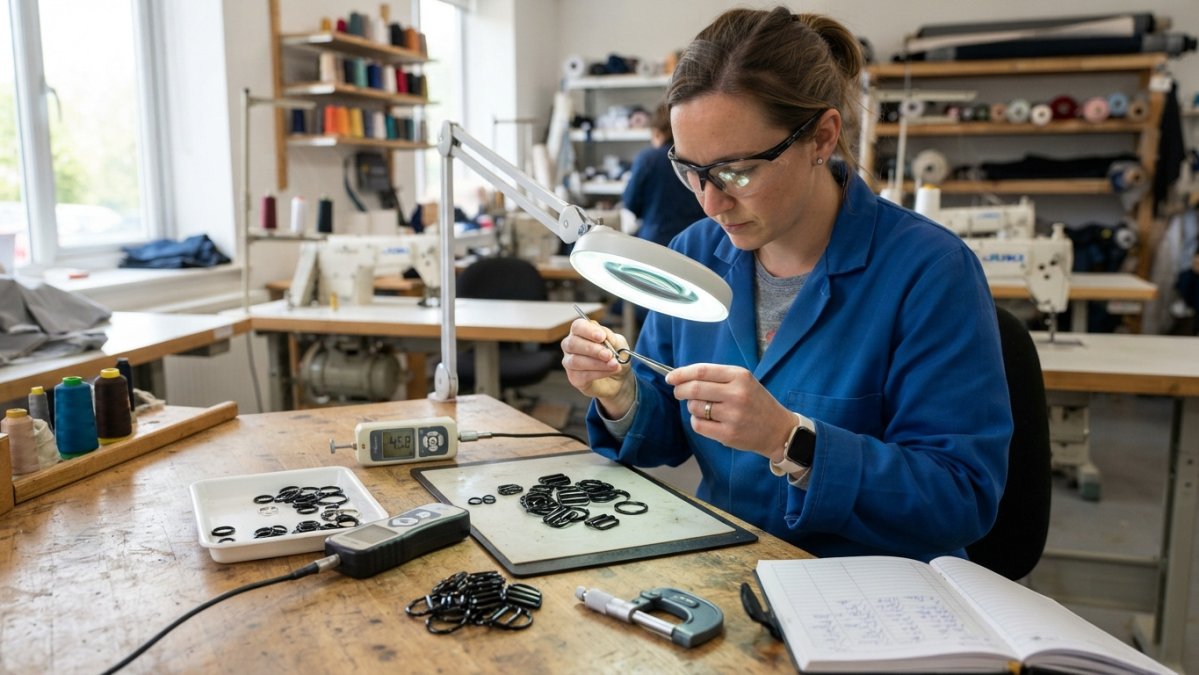
A quality control technician inspecting nylon-coated steel rings and sliders on a bench in a bright textile workshop shows what this checking looks like in practice.
Ask your supplier for the certificate and check that it covers the exact item you order, not just the product family.
- Request test reports for each component code
- Confirm the certificate number and expiry date
- Store the documents with your technical file
The checks that show your hardware is safe, and the records that prove them, come down to these points:
| Step | What to check | Frequency |
|---|---|---|
| Test reports | Request one per component code | Each component |
| Certificate | Confirm number and expiry date | Before first order |
| Certificate scope | Covers the exact item ordered | Each order |
| Documentation | Store with technical file | Ongoing |
GPSR Traceability and Technical Documentation Checklist
Use this checklist to keep your records audit-ready.
- Each component has a unique product or batch reference
- Supplier name and contact details are on file
- Safety test reports are linked to the batch number
- Risk assessment is dated and signed off
- Labels or product information show the required warnings
- Recall and corrective action steps are written down
If an authority asks where a part came from, you should be able to answer within a day.
How REACH and GPSR Obligations Work Together for Hardware
REACH governs chemical substances in products, and GPSR governs overall product safety. For hardware, the two overlap on coatings, finishes and metals. A component can pass a chemical check and still fail a physical safety test, so you need both views.
Compliance evidence should be kept for every component you buy, whatever its supplier. Read the Sourcing REACH-Compliant Components for Apparel: A Buyer's Guide for the chemical side of these obligations.
Preventing Garment Component Recalls: Supplier and Sourcing Steps
Most recalls start with a supplier change that nobody documented. Lock down your sourcing before problems appear.
- Approve each supplier before the first order
- Require test reports with every new batch
- Re-check certificates when a component code changes
- Keep a sample from every batch for at least the life of the product
For a deeper look at how recalls happen and how to avoid them, read how garment component recalls happen and how to avoid them.
Confirming Your Hardware Sourcing Plan Before Your 2026 Orders
Before you place 2026 orders, separate what is already in force from what is still moving. The GPSR has applied since 13 December 2024, so the core obligations, risk assessment, technical documentation, traceability, responsible person, and listing information, are active requirements for 2026 orders, not future ones. What changes in 2026 is less about a new GPSR start date and more about how enforcement, market surveillance, and adjacent rules mature.
What applies to 2026 orders. Treat the following as live requirements for any apparel hardware placed on the EU market in 2026: a documented risk assessment per component, a technical file that links test evidence to batch references, an EU-based responsible person where your sales model requires one, traceability information that lets you identify the supplier and batch, and accurate safety and identification information in online listings. These are the points an authority is most likely to request first.
What is still a proposal or future measure. The EU's broader textile and digital product passport work is often discussed alongside GPSR, but proposals and future measures should not be presented to buyers as current obligations. Keep them in a separate horizon-scanning file and label them as proposed or forthcoming, so your compliance documentation reflects enacted requirements only. Mixing proposals into your technical file creates confusion in an audit and can make your evidence look unreliable.
A practical 2026 sourcing sequence.
- Map every hardware component to its supplier, component code, finish specification, and intended user group.
- Confirm that each component has a current test report or certificate that covers the exact item ordered, not just the product family.
- Re-run the risk assessment where the intended user, attachment method, or finish has changed since the last assessment.
- Check that online listings carry the identification and safety information the GPSR requires for the offer.
- Confirm who your EU-based responsible person is and that their details are current.
- Set a change-notification expectation with each supplier so a material or finish substitution does not arrive undocumented.
Where 2026 orders most often go wrong. A common pattern is a supplier substituting a finish or a base metal mid-season without updating the certificate, leaving the buyer with documentation that no longer matches the shipped component. Another is a listing that carries a safety warning but omits the responsible person's details. Both are avoidable with a change-notification clause and a listing check before publication.
If you are still choosing components, Beige Nylon Coated Steel Rings are available from Allied Trimmings, and their listing describes them as lead-free, nickel-free and Oeko-Tex 100 certified. For a full planning guide, see sourcing hardware for small apparel brands, and check the Made in France beige nylon coated steel slider if you need matching hardware for a tested specification.


Frequently Asked Questions
What does the EU General Product Safety Regulation require for apparel hardware?
The GPSR has applied since 13 December 2024 and covers consumer products sold in the EU, including products sold online and new or used goods. For apparel hardware such as snaps, hooks, sliders and rings, this means the product must be safe for its intended use, supported by a documented risk assessment, and identifiable through traceability information. Products must also carry the required safety and contact information. Business owners should confirm which obligations apply to their specific sales model, since responsibilities differ for manufacturers, importers and distributors.
Does the GPSR apply to garment components such as snaps, hooks, sliders, and rings?
Yes, garment components sold to consumers in the EU fall within the scope of the GPSR, as they are consumer products. The regulation also covers products designed exclusively for professional use if they subsequently reach the consumer market. Components sold to brands for incorporation into garments should be assessed for their role in the finished product, because a hook or slider that could cause injury or skin reactions in the final garment is part of the safety picture regardless of how it was sold.
What should an apparel business do if a hardware component may pose a safety risk?
Start by documenting the suspected risk and identifying affected batches using traceability records. Assess whether the component could cause harm in normal or foreseeable use, then decide whether to stop sales, withdraw affected stock or issue a recall. Notify your supplier and relevant market surveillance authorities where required. Keeping clear batch identification and supplier records makes it possible to act on a specific lot rather than an entire product range, which limits both consumer harm and business disruption.


