


Last Updated: October 28, 2026
Quick Summary
Sourcing REACH-compliant components for apparel means proving every trim, slider, ring, hook, and closure meets EU chemical restrictions at the article level, not just the fabric level. A mill's OEKO-TEX certificate says nothing about the nickel release rate of a slider, so component compliance is a separate file with separate obligations.
- A garment is an article containing multiple sub-articles, each with its own substance obligations under REACH.
- A workable compliance file for each component contains four layers, each with a specific review test.
- The practical rule: declaration for every component, test report for every high-risk component, and a change notification clause.
- Test high-risk skin-contact metal every new supplier and every material change; test low-risk decorative trim on supplier change only.
- A supplier may submit a polished, uncoated sample while shipping a coated production part, so identify samples by article number and photograph.
Table of Contents
- What Sourcing REACH-Compliant Components for Apparel Really Requires
- Why Component-Level Compliance Is Different From Fabric Compliance
- REACH Restricted Substances in Textiles: What Applies to Trims and Hardware
- Supplier Evidence and Document Review: Building Your Compliance File
- Garment Hardware Safety Testing: A Risk-Based Sampling Strategy
- The REACH Compliance Certificate for Apparel: What to Ask For
- How to Avoid Garment Component Recalls: Traceability and Change Control
- Choosing a Component Supplier You Can Audit
- Request Test Reports and Samples From Allied Trimmings
- Frequently Asked Questions
What Sourcing REACH-Compliant Components for Apparel Really Requires
Sourcing REACH-compliant components for apparel means proving every trim, slider, ring, hook, and closure meets EU chemical restrictions at the article level, not just the fabric level. At Allied Trimmings, we have supplied European-made trims since 1981.
A fabric mill's OEKO-TEX certificate tells you nothing about the nickel release rate of the slider on your bra strap. Component compliance is a separate file, with separate obligations.
Why Component-Level Compliance Is Different From Fabric Compliance
Under REACH, a garment is an "article" containing multiple sub-articles, shell fabric, lining, elastic, metal hardware, plastic closures, each with its own substance obligations. A mill's material declaration covers dye chemistry and fibre content, not the plating on a hook-and-eye, the nickel in a steel ring, or the plasticiser in a coated slider.
That gap is where recalls originate. For a deeper look at preventing them, see how to avoid garment component recalls. The European Chemicals Agency's guidance on articles sets out these article-level duties, and they do not merge into a single supplier certificate.
REACH Restricted Substances in Textiles: What Applies to Trims and Hardware
"REACH compliant" is nearly meaningless without scope.
For buyers selecting durable hardware, material choice and coating quality determine much of the compliance profile.
Supplier Evidence and Document Review: Building Your Compliance File
A workable compliance file for each component contains four layers, each with a specific review test:
How to Validate a Test Report Before You Rely on It
- Which laboratory issued it, and is the accreditation visible? Look for an accreditation number and scope on the report. A laboratory without textile or consumer-goods accreditation is weak evidence.
- Which substances were tested, and at what detection limit? The report should list the restricted substance, the method, and the limit of detection. For nickel release, the method should be the standard release method, not a total-content test.
- Which sample was tested? The report should identify the sample by article number, photograph, or both. A report identifying only "metal slider" cannot be tied to the slider on your purchase order.
- Which regulatory version does it reference? The report should name the Candidate List version or restriction entry it was tested against. A report older than the current Candidate List update needs a gap assessment, not automatic acceptance.
- Is the report complete? Check for page numbering, signatures, and annexes. A partial PDF with the summary page only is not a report.
What a Supplier Declaration Does and Does Not Prove
The practical rule most buyers settle on: declaration for every component, test report for every high-risk component, and a change notification clause for every supplier.
Linking Evidence to the Component: Traceability Records
This is the component-level traceability that competitors describe in principle but rarely show in practice. The European Chemicals Agency's guidance on articles sets out the article-level duties, and the record-keeping discipline above is how you demonstrate them when a customer or regulator asks.
Garment Hardware Safety Testing: A Risk-Based Sampling Strategy
| Risk Tier | Component Type | Testing Frequency | Rationale |
|---|---|---|---|
| High | Skin-contact metal: sliders, rings, hooks | Every new supplier and every material change | Nickel release and lead exposure |
| Medium | Coated plastic closures | Annual or per colour change | Plasticiser and coating chemistry |
| Low | Non-contact decorative trim | On supplier change only | Minimal exposure pathway |
When to Test: Triggers, Not Calendars
- Adverse signal. A customer complaint, market surveillance alert, or supplier quality issue is a trigger to test, not a reason to wait for the annual cycle.
How to Select Representative Samples
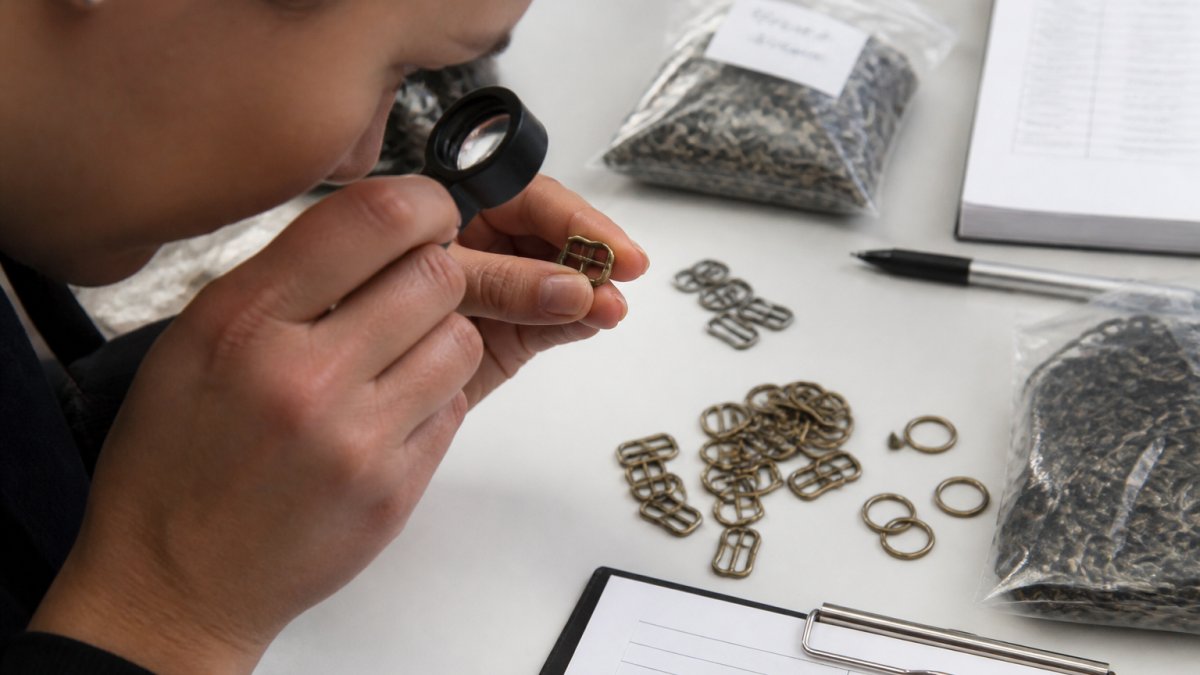
A common failure pattern: a supplier submits a polished, uncoated sample for testing while shipping a coated production part. Readers weighing skin-contact metals can learn whether skin-safe metal components for lingerie are worth it. The report is valid for the sample and useless for the shipment. Sample identification and photographs close that gap.
Ring - Beige Nylon Coated Steel Rings (10, 12, 16mm) Pantone 14-1212 Frappe. →
How to Respond to a Failed Test
- Quarantine the affected lot and stop shipment until the failure is understood.
- Ask the supplier for a root-cause explanation covering material source, process, and any recent change.
- Re-test a second sample from the same lot and, separately, from a new production run to determine whether the failure is lot-specific or process-wide.
- Require corrective action with a defined change (new plating vendor, alloy source, or coating formulation) and re-test the changed part before release.
- Update the compliance file with the failure, corrective action, and new evidence, so the record shows the resolution, not only the original report.
The REACH Compliance Certificate for Apparel: What to Ask For
- Which accredited laboratory produced the test report, and what is its accreditation number?
- Which substance list and Candidate List version does the report reference?
- Does the report identify the specific component by article number or only by material family?
- What is the detection limit for nickel and lead in the tested samples?
- What is your written process for notifying customers of material or process changes?
How to Avoid Garment Component Recalls: Traceability and Change Control
A 2023 case study on apparel supply-chain traceability documented both the progress and the persistent gaps in this area, and the pattern holds for trims specifically: traceability breaks at the component tier, not the fabric tier. The FASH455 traceability case study describes how even advanced brands struggle to trace below the assembly level.
Choosing a Component Supplier You Can Audit
Practical guidance on vetting trim suppliers, including the questions that separate manufacturers from resellers, is in our guide on how to find reliable garment trim suppliers.
Request Test Reports and Samples From Allied Trimmings
Our components are independently tested and skin-safe. Our nylon-coated steel sliders and rings are 100% lead-free and nickel-free, Oeko-Tex 100 certified, and available in dyeable white, beige, and amaranth. They are suitable for lingerie, swimwear, and shapewear.
You can view our nylon-coated steel slider range.

Frequently Asked Questions
What does REACH compliance mean for apparel components?
Sourcing REACH-compliant components means getting documented evidence from the supplier, not just a verbal assurance that the item is skin-safe.
Which garment components may need to meet REACH requirements?
Any article placed on the EU market falls within REACH scope. In practice, buyers focus on the parts that touch skin or carry coatings: bra rings and sliders, hooks and eyes, underwires, zips, snaps, rivets, eyelets, and coated metal trims. Nylon-coated steel hardware, for example, needs lead and nickel declarations plus coating checks. Fabric, thread, and labels also count, but component-level sourcing is where most documentation gaps appear.
Does a supplier declaration alone prove that a component is REACH compliant?
No. A declaration is a statement of intent and it is only as good as the testing behind it. Ask for the underlying test reports, the laboratory name, the test method, and the date. Check that the report covers the specific colour, coating, and size you are ordering, because a report for a different finish does not transfer. A declaration plus a current report from an independent lab is the combination that holds up in an audit.
How often should apparel components be tested for restricted substances?
Test on a risk-based cycle rather than a fixed calendar. Retest when a supplier changes material, coating, dye, or production site, and at least annually for high-risk items such as skin-contact metal hardware. Keep a rolling schedule so every component family is covered within a defined window. If a supplier cannot confirm when an item was last tested, treat it as untested and commission a fresh report before ordering.
What should brands do if a component fails a chemical compliance test?
Quarantine the stock and stop shipment immediately. Ask the supplier for a root-cause explanation covering material, coating, and process. Commission a retest on a fresh sample from a different batch to confirm whether the failure is isolated or systemic. If it is systemic, switch suppliers or switch to a certified alternative. Document the whole sequence, because regulators and retail partners will ask for it if the item has already reached the market.
How do REACH and GPSR requirements differ for apparel components?
REACH governs chemical content: restricted substances and SVHC declaration. GPSR governs product safety and information duties, including traceability, responsible person details, and risk communication for consumer products in the EU. A component can pass REACH and still fail GPSR paperwork if the supply chain cannot identify the economic operator. Treat them as two separate checklists and confirm both with your supplier before the goods ship.
How can I verify that a supplier's REACH-compliant components are independently tested?
Allied Trimmings supplies independently tested, skin-safe components made in France, including Oeko-Tex 100 certified nylon-coated steel rings and sliders that are lead-free and nickel-free.
If your current hardware supplier cannot produce a test report scoped to the exact part you buy, that is the risk in your supply chain, not the price per unit. Allied Trimmings supplies independently tested, REACH and GPSR-ready components with the documentation attached, so your compliance file is complete before your first production run. Get started with Allied Trimmings and source hardware you can defend.


