


Quick Summary
Durable hardware for high performance activewear comes from specifying each component by its failure mode, not by unit price. Hooks, sliders, rings and underwires each fail differently, so match the component family to the load and environment, then confirm coating, finish and certification with samples before ordering.
- Hooks and bra bands fail through deformation and coating wear, so check wire gauge and wash-cycle results.
- Check slider hole height against your elastic thickness, then test the slider on the actual elastic before approving.
- Specify hardware for the highest load it will see in use, then add margin for real-world abuse.
- Test the assembled closure under real movements, not the component alone, before approving production.
Table of Contents
- Why Hardware Fails Before the Fabric Does
- Activewear Hardware Components Worth Specifying
- Sweat-Resistant Apparel Hardware: Coatings and Corrosion
- Skin-Safe Clothing Hardware and Chafing Risk
- REACH-Compliant Apparel Components: What to Ask For
- Matching Hardware to Garment Type and Load
- Specifying Your Next Hardware Order
- Frequently Asked Questions
Durable Hardware for Activewear: Zippers, Hooks and Sliders
Last Updated: October 30, 2026
Why Hardware Fails Before the Fabric Does
Durable hardware is the first thing that gives way in a garment that is otherwise built to last. Allied Trimmings has supplied European-made trimmings and components since 1981, and designers often ask how to specify hooks, sliders and rings that survive the same wear as the fabric around them. Fabric gets the attention in most performance apparel guides, but a snapped slider or a corroded ring ends a garment's life just as surely.
Hardware sits under constant stress. Every strap adjustment, every closure and every stretch cycle loads the metal or plastic at the same few points. A slider that grips well in a fitting room can slip after a few weeks of daily training, and a hook that holds a bra band can deform under repeated load. These are predictable failure modes, and they can be specified against.
Many brands treat trimmings as an afterthought at the sampling stage. That is where the trouble starts. Choosing components late, or by unit price alone, tends to surface as returns and rework months later.
Activewear Hardware Components Worth Specifying
Most activewear and intimate apparel relies on a small group of components: hooks, sliders, rings, underwires and, in outdoor or heavy-use garments, plastic loops and ladder locks. Each has a different job, and each fails in a different way. Specifying well means knowing the failure mode before you choose the part.
Hooks and eyes (bra bands, closures). A common failure mode is deformation and coating wear. Repeated load on a bra band bends the hook wire; once it deforms, the hook no longer seats in the eye and the band slips. Look for consistent wire gauge across the size run, a coating that survives wash cycles without flaking, and a hook geometry that stays engaged under tension.
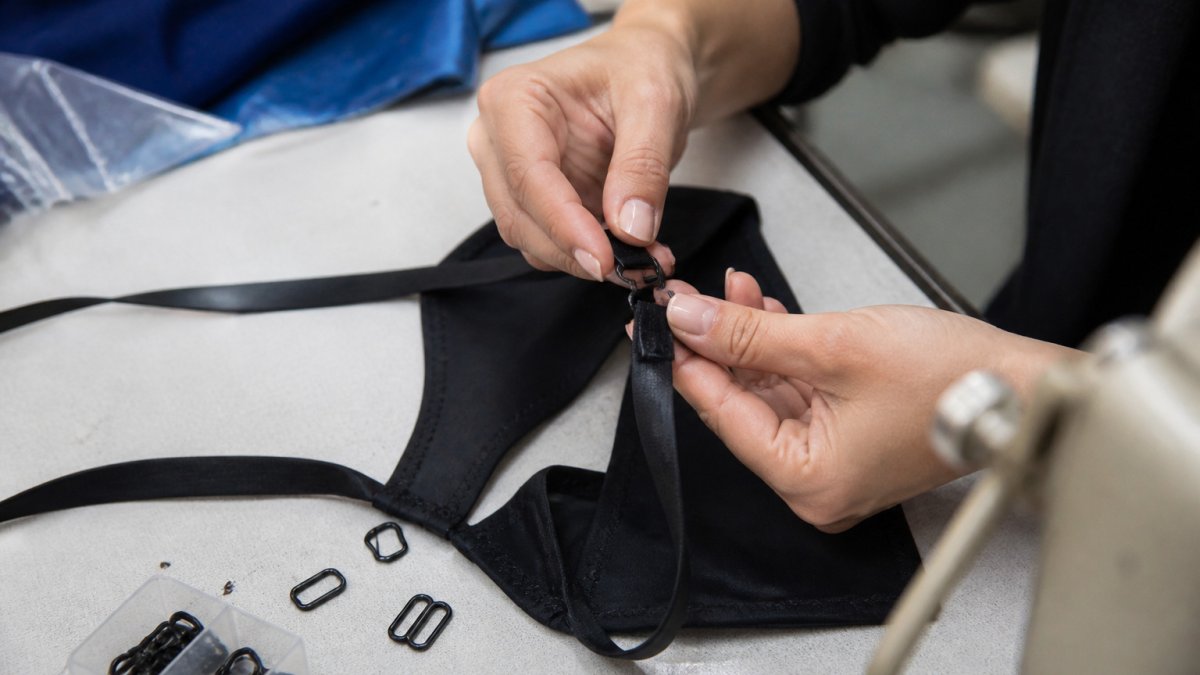
Sliders (strap adjustment). The failure mode is grip loss: the slider stops holding the strap at the set length, so the wearer re-adjusts constantly. That comes from hole geometry, material stiffness, and coating wear. For double-strap elastic, XXL slider adjusters with 5mm tall holes are designed for double-strap elastic on lingerie and swimwear. Browse the black XXL slider range to compare dimensions for your garment. Check the hole height against your elastic thickness before ordering, and test the slider on the actual elastic before approving.

Rings (straps, adjustable closures). Rings can be affected by coating wear. Nylon-coated rings are available for adjustable closures; confirm the finish colour is consistent across bulk packs.
Underwires (bra cups). The failure mode is tip poke-through and coating wear at the tip. Nylon-coated underwire built from galvanized carbon steel with a nylon (PET) coating is available from Allied Trimmings; inspect samples after a wash and abrasion cycle.
Plastic D rings and ladder locks (outdoor webbing, heavy loads). These are a different category. Their published breaking strengths run from 30 kg on a 3/4-inch ladder lock to 70 kg on a 2-inch D ring, which gives you a reference point when comparing load requirements. Treat these as reference figures, since actual performance depends on the application and should be tested in your own garment.
Quick guide by component:
| Component | Typical use | Primary failure mode | What to check |
|---|---|---|---|
| Nylon-coated steel hook | Bra bands, closures | Deformation, coating wear | Wire gauge, wash-cycle sample |
| XXL double-strap slider | Double-strap elastic | Grip loss | Hole height vs. elastic thickness, cycle test |
| Nylon-coated ring | Straps, adjustable closures | Coating wear, edge sharpness | Edge radius, finish consistency |
| Underwire | Bra cups | Tip poke-through | Gauge, tip type, tip coating |
| Plastic D ring / ladder lock | Outdoor webbing, heavy loads | Load failure, UV aging | Breaking strength, size, UV exposure |
Many brands treat trimmings as an afterthought at the sampling stage. That is where the trouble starts. Choosing components late, or by unit price alone, tends to surface as returns and rework months later.
Sweat-Resistant Apparel Hardware: Coatings and Corrosion
Sweat is a practical enemy of metal hardware. Salt residue and repeated moisture can degrade unprotected steel over time, which is why coating choice matters for performance wear.
Nylon-coated steel addresses this by sealing the metal from direct exposure. Our nylon-coated underwire is built from galvanized carbon steel with a nylon (PET) coating. Inspect samples after a wash and abrasion cycle before committing to volume.
Plastic components, such as the polyoxymethylene (POM) ladder locks and D rings, are made of POM. Match them to the actual stress in the garment.
Run a wash test on your own fabric combination before approving production quantities.
Skin-Safe Clothing Hardware and Chafing Risk
Hardware that touches skin for hours, such as a bra band hook or a swimsuit strap slider, raises two separate concerns: allergic reaction and mechanical chafing. The first depends on what the metal is and what it is plated or coated with. The second depends on edge finish and fit.
Nickel content is a reasonable first filter when checking metal trims. Our article on whether skin-safe metal components are worth the cost for lingerie weighs the trade-offs. The sliders and rings in our nylon-coated range are described as 100% lead-free and nickel-free and carry Oeko-Tex 100 certification. The underwire listings state 100% nickel and lead free. Always request the current certificate for the exact SKU you order rather than relying on a general product description.
Hook - Black Nylon Coated Steel (8mm to 25mm) Made in France →
Chafing is a fit and finish question. Sample the hardware against bare skin under movement before signing off a style.
REACH-Compliant Apparel Components: What to Ask For
REACH is the EU regulation governing chemical substances, and it applies to trimmings sold into European supply chains. Our buyer's guide to sourcing REACH-compliant components walks through what to request from suppliers. If you sell into the EU, ask your supplier for documentation rather than assuming compliance.
Reasonable requests include a declaration of compliance covering the specific SKU, the material composition (for example, galvanized carbon steel with a PET coating), and the certification number behind any Oeko-Tex claim. Ask whether the components were independently tested and by whom. Ask how the supplier handles product changes, since a finish or coating switch can alter compliance status.
GPSR, the General Product Safety Regulation, adds obligations around product safety in the EU market (EU's General Product Safety Regulation (GPSR): A New Era of Consumer Protection). Confirm with your own compliance adviser which requirements apply to your garment category and destination market. Contact us to ask what documentation is available for the nylon-coated range; your own due diligence remains your responsibility.
Matching Hardware to Garment Type and Load
Load and movement determine the right component. A lingerie strap slider faces light, repetitive adjustment. A training garment with a drawcord or an outdoor piece with webbing faces heavier pulls and more abrasion. The useful exercise is to map each garment type to its load points, then specify against the highest load it will see in use, plus margin for real-world abuse.
Leggings and training tights. Hardware is minimal here: drawcords, cord locks, and any waistband adjusters are the main components. Avoid metal where the wearer will lie on the floor or against equipment; plastic or coated components reduce pressure points.
Sports bras. Hooks, sliders, rings, and underwires all appear here, and the load is repetitive rather than heavy. The failure modes are hook deformation, slider grip loss, and underwire tip poke-through. Coated steel hooks, sliders and underwires are among the components suited to sports bras; check that slider hole height matches your strap elastic.
Jackets and outer layers. Zippers, snaps, drawcord locks, and cord-end hardware dominate. The failure modes are zipper slider wear, snap pull-out, and cord-lock cracking in cold or UV exposure. Hardware placement matters: a zipper pull that contacts a pack strap or a chin guard wears faster than one that does not.
Training shorts. Drawcords, cord locks, and occasionally snaps or small buckles are the components. The failure modes are cord-lock grip loss and abrasion from equipment contact. Specify low-profile, rounded components, and test the drawcord under the movements the wearer will actually make, sprinting, squatting, and contact with bars or mats.
Swimwear and water-sports pieces. Sliders, rings, and hooks face salt water, chlorine, and repeated wet-dry cycles. The failure modes are corrosion (on metal) and coating wear. Nylon-coated steel and plastic components are both options; match the part to the actual stress in the garment.
Outdoor and utility webbing. D rings, ladder locks, and heavier sliders face the highest loads and the most abrasion. Plastic D rings in 3/4, 1, 1 1/2 and 2-inch sizes give you a load range, with breaking strengths listed on each product.
Nylon-coated steel hooks, rings and sliders are available for bras and swimwear. The XXL slider is available in black or white; check the width against your strap elastic before ordering. For outdoor and utility webbing, plastic D rings in 3/4, 1, 1 1/2 and 2-inch sizes give you the load range you need, with the breaking strengths listed on each product.
Specifying Your Next Hardware Order
Start with the garment's use: intimate, swimwear, training or outdoor. Then list the load points, the fabric it attaches to, and the environment it will face, including salt water and sweat. Match each point to a component family, confirm the finish and certification for your destination market, and request samples.
Order quantities matter too. Our products ship in bulk, and the nylon-coated sliders come in packs of 100. Contact us for wholesale pricing on the items that list it.
Browse the full range to compare the sliders, hooks and rings we offer: choose the trimmings you need from our range.

Frequently Asked Questions
How do I know if apparel hardware is really independently tested?
Ask the supplier for the test reports behind any skin-safety or compliance claim, and check that the testing lab is independent of the seller. Allied Trimmings states that its components are independently tested, skin-safe and built to REACH and GPSR requirements, so request the certificates for the specific hook, slider or ring you plan to order rather than accepting a general statement. Keep the batch or SKU references with your production records so you can trace any component if a question comes up later.
Are nylon-coated steel hooks suitable for swimwear?
Nylon-coated steel hooks such as the black hook sold by Allied Trimmings are designed for bras, dresses and swimwear, where they provide an adjustable closure with a smooth, secure hold that is gentle on fabric. Choose the size that matches your closure width and test a sample against your own stretch fabric and wash cycle before committing to a bulk run. For swimwear that will see chlorine or sea water, ask for coating and corrosion data specific to that exposure.
Can small brands order durable hardware in low quantities?
Allied Trimmings supplies bulk packs, and several components such as the sliders list a 100-piece order, so smaller brands should confirm minimum quantities for each item before planning a collection. Starting prices in the catalogue are from 1.00 for sliders and hooks, from 1.50 for ladder locks and from 3.00 for D rings, but final unit costs depend on quantity and freight, which are not included in the listed prices. Request a quote for your expected monthly volume.
What should I check when sourcing hardware for a contract factory?
Specify the exact SKU, size, colour and coating in your tech pack so the contract factory orders the same component each time. Confirm the component is nickel-free and lead-free, ask for the country of origin, and agree on who places the order with the hardware supplier. Request a pre-production sample and run it through your own wash and friction tests before the factory starts full production.


