


Last Updated: November 17, 2026
Quick Summary
To choose bra rings by size, match the ring's inner width to your finished strap width, not its outer width. Measure the strap flat and unstretched, then pick a ring whose inner opening lets the strap slide freely without bunching. Always confirm with the supplier that the quoted size means inner width in millimetres.
- A ring's inner width equals outer width minus twice the wire diameter.
- Common production ring sizes are 10mm, 13mm, 16mm, and 19mm.
- Measure rings with digital calipers, not a flexible tape, for reorders.
- Start a 10-12mm strap with a 13mm ring and allow 1-2mm clearance.
- Order the ring and slider as a matched set to prevent strap twisting.
Table of Contents
- Bra Ring Sizing Basics: What the Numbers Actually Measure
- How to Measure Bra Strap Width Before You Pick a Ring
- Bra Strap Hardware Sizes: Matching Rings to Strap Width
- Choosing Durable Lingerie Hardware Components That Last
- REACH Compliant Bra Hardware: What to Ask Your Supplier
- Troubleshooting Common Bra Ring Sizing Mistakes
- Ordering Bra Rings for Your Next Production Run
- Frequently Asked Questions
Bra Ring Sizing Basics: What the Numbers Actually Measure
A bra ring's size is defined by its inner width, the measurement across the inside of the loop where the strap passes through. Most sizing errors start with a simple mix-up: buyers read the outer width and order a ring that pinches the strap. This guide on how to choose bra rings by size walks through the numbers, the measuring steps, and the supplier questions that prevent costly reorders.
Four dimensions matter when you spec a ring, and only one of them should drive your size choice:
- Inner width is the clear opening inside the ring, measured from the inside edge of the wire on one side to the inside edge on the opposite side. This is the dimension that must match the strap width. It is the number to build a size chart around.
- Outer width is the full outside diameter, including the metal thickness on both sides. It matters for clearance inside channeling or casings and for the finished look, but it is not the fit dimension.
- Wire diameter is the thickness of the metal itself, measured across the wire. It affects strength, how the ring sits against the body, and how the ring pairs with a slider or adjuster.
- Material thickness (sometimes called gauge) is the wire diameter expressed as a gauge number rather than a millimetre measurement. Suppliers vary in whether they quote gauge or millimetres, so confirm the unit before comparing quotes.
A 10mm ring with a 2mm wire has roughly a 6mm inner opening, which is why two rings labeled the same size can behave very differently on the same strap. The relationship is simple: inner width equals outer width minus twice the wire diameter. If a supplier quotes only one number, ask which dimension it represents before you order.
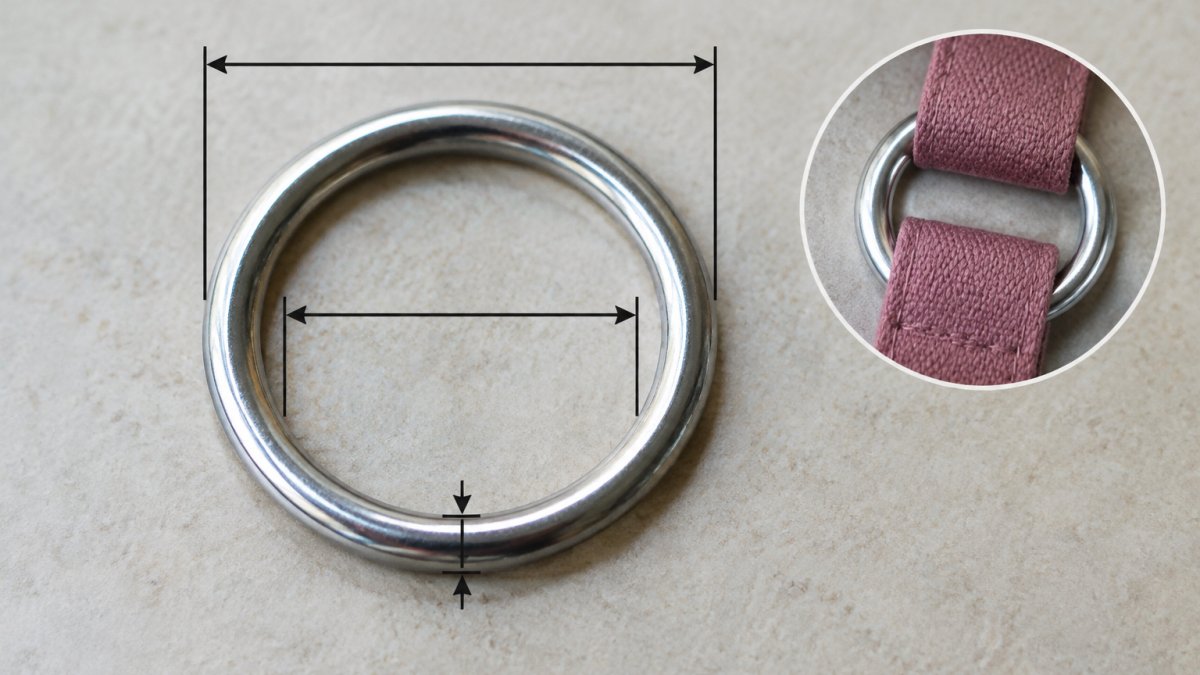
Ring sizes are usually stated in millimetres, and the four numbers we see most often in production specs are 10mm, 13mm, 16mm, and 19mm. Those numbers are often used to refer to inner width, but that convention is not universal. A supplier quoting 10mm could mean a 10mm outer width with a 6mm opening, which would be far too small for a standard bra strap. Always confirm the convention in writing before a bulk order.
To measure a ring you already have, use digital calipers rather than a ruler. Measure the inner opening at its widest point, then measure the outer width at its widest point, then measure the wire diameter at the side of the ring where the strap rubs. The three numbers should be internally consistent: outer width minus twice the wire diameter should equal the inner width within a tolerance of about 0.2mm.
If you want to see how a full size range maps onto real hardware, the white bronze plated alloy rings in 6mm to 19mm are available in six sizes.
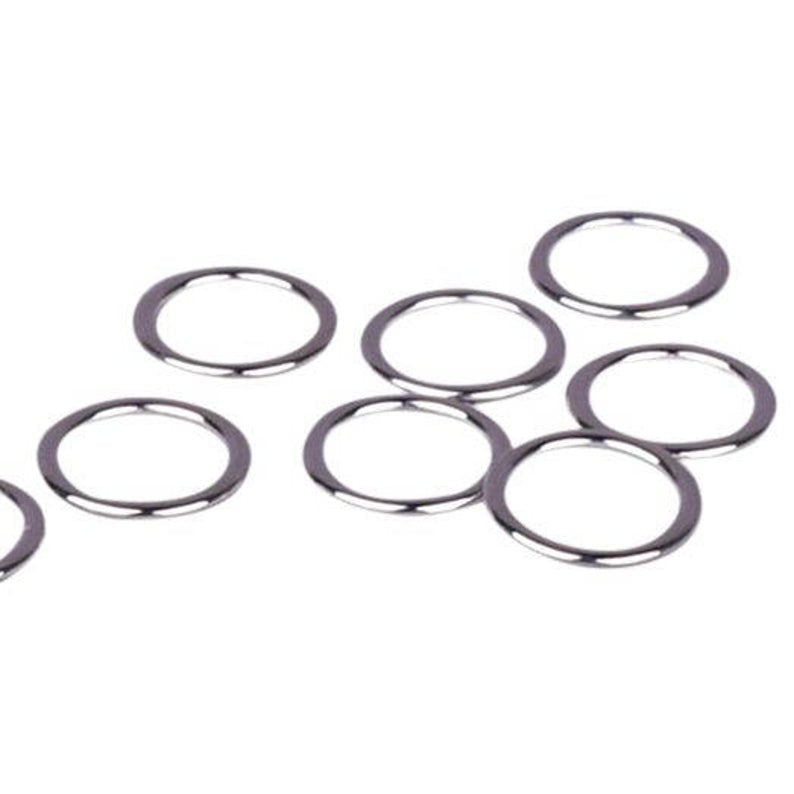
Watch out: measuring a ring with a flexible tape instead of calipers introduces enough error to misjudge a size, especially on rings under 13mm where a 1mm difference changes the fit. Use calipers for any ring you intend to reorder.
How to Measure Bra Strap Width Before You Pick a Ring
Measure the strap's finished width with a flexible measuring tape, flat and unstretched, at the point where the ring will sit. The ring's inner width should exceed the strap width slightly so the strap slides freely without bunching.
Follow these steps:
- Cut a 10cm sample of the finished strap or elastic.
- Lay it flat on a bench and measure across its width with a flexible measuring tape.
- Repeat at three points along the sample and average the readings.
- Add clearance for the ring's inner opening: enough for the strap to move without folding, not so much that the ring slides out of position.
- Check the ring's wire diameter and confirm the outer width clears any casing or channeling.
Watch out: measuring a stretched elastic gives a false width, and the ring will be undersized once the garment relaxes.
Bra Strap Hardware Sizes: Matching Rings to Strap Width
Match the ring's inner width to the finished strap width, then confirm the outer width clears your construction. The table below is the working reference we use when specing rings against common strap widths. It assumes a wire diameter of roughly 1.5-2.5mm; if your supplier's wire is thicker, the outer width grows even when the inner opening stays the same, so always confirm which dimension the size number refers to.
| Strap Width | Ring Size to Start With (Inner Width) | Typical Outer Width at 2mm Wire | Typical Use | Check Before Ordering |
|---|---|---|---|---|
| 6-8mm | 10mm | ~14mm | Light lingerie, camisole straps | Inner opening vs. elastic thickness; ring must not pinch a folded strap |
| 10-12mm | 13mm | ~17mm | Standard bra straps, bralettes | Strap fold at the ring; allow 1-2mm clearance so the strap slides without bunching |
| 13-15mm | 16mm | ~20mm | Support bras, swimwear | Casing clearance; confirm the ring fits through any channeling before ordering |
| 16-19mm | 19mm | ~23mm | Wide straps, sports styles | Ring strength under load; thicker straps need a heavier wire to hold tension |
Use this chart as a starting point, not a final spec.
A common pattern in production is to order the ring and slider as a matched set rather than mixing sizes from different suppliers. When the ring's inner width and the slider's slot width are mismatched, the strap tends to twist between the two components, which shows up as a fit complaint long after the garment ships. If you are replacing hardware on an existing bra, measure the old ring's inner width with calipers and match it rather than sizing up or down from the strap alone.
For nickel-finished options across 10, 13, 16, and 19mm, the nickel plated alloy rings made in France are available in four sizes.
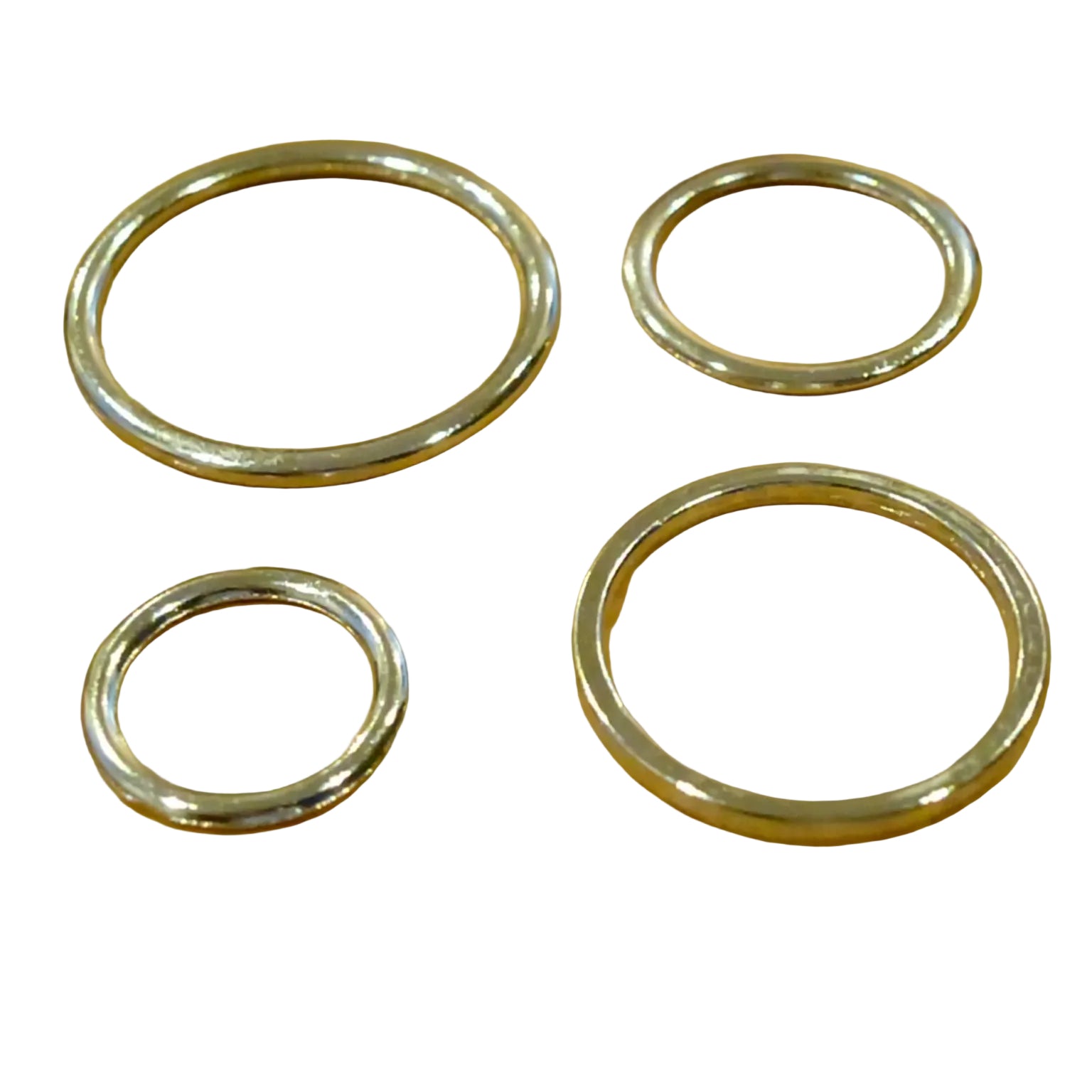
Watch out: a ring that measures correctly on a flat strap can still bind once the strap is sewn into a casing, because the seam allowance reduces the effective opening. Test the ring on a sewn sample, not just a loose strap end.
Ring size to start with by finished strap width
Choosing Durable Lingerie Hardware Components That Last
Durability in lingerie hardware depends on the base alloy, the plating quality, and how the ring is finished. Ask for plating thickness specs and wash-test results, not just a material name. Our guide to durable apparel hardware components goes deeper on the criteria worth putting in a spec sheet.
REACH Compliant Bra Hardware: What to Ask Your Supplier
REACH compliance for bra hardware means the components meet the EU regulation on chemicals, with documentation to prove it. Ask for the test report, the lab that issued it, and the date, then confirm the report covers the specific finish and size you're ordering.
Questions worth putting in writing:
- Which independent lab tested this component, and can you share the full report?
- Does the report cover this exact finish and size, or a different one in the range?
- How often is testing repeated, and what happens when a finish changes?
- What documentation accompanies each shipment?
A buyer's guide to sourcing REACH-compliant components for apparel sets out the specific paperwork to request. Allied Trimmings supplies independently tested, skin-safe components that are REACH and GPSR ready, which is the baseline any lingerie brand should expect from a hardware supplier.
Troubleshooting Common Bra Ring Sizing Mistakes
Most ring sizing problems trace back to one of four causes, and each has a straightforward fix.
- Ring too small: the strap folds or bunches at the ring. Move up one size and re-check the inner opening.
- Ring too large: the ring slides and the strap loses tension. Drop a size or increase strap width.
- Plating wear: finish dulls at the rub point. Check plating thickness and wash-test data.
- Inconsistent sizing between batches: confirm the supplier measures inner width, not outer.
Skin sensitivity is the fourth issue worth flagging. Readers troubleshooting fit and skin comfort together may want to weigh whether skin-safe metal components for lingerie are worth specifying.
Ordering Bra Rings for Your Next Production Run
Order against a written spec, not a photo. State the ring size in millimetres, whether that number is inner or outer width, the finish, the wire diameter tolerance, and the compliance documentation required with each shipment.
A short pre-order checklist:
- Finished strap width measured and averaged
- Ring size confirmed as inner width in millimetres
- Outer width checked against casing clearance
- Finish and plating spec agreed in writing
- REACH test report requested and reviewed
- Sample ring tested on a finished strap before the bulk order
Allied Trimmings has supplied European-made, jewelry-quality trimmings since 1981, with independently tested, skin-safe hardware built for lingerie, swimwear, and outdoor production. Our rings are made in France and are REACH and GPSR ready.
Frequently Asked Questions
What are the standard sizes for bra rings and sliders?
Bra rings and sliders are usually sold in metric sizes that correspond to the strap width they accept, commonly 6mm, 10mm, 13mm, 16mm, and 19mm. The size refers to the inner opening, so a 10mm ring fits a 10mm strap. Always check whether a supplier lists inner width or outer width, because the outer dimension is larger and will not tell you what strap fits. Order a sample card before committing to a full production run.
How does strap width determine the size of the bra ring needed?
The ring's inner opening must be wide enough for the strap to pass through and slide freely without bunching or twisting. As a rule, match the ring's inner width to the strap's finished width. A strap that is too wide for the ring will pucker at the fold, while a strap that is too narrow will slip and wear unevenly. If your strap is between sizes, size up and adjust the strap fold rather than forcing a tight fit.
Why is material quality important when choosing bra hardware?
Bra hardware sits against skin for hours and is exposed to sweat, detergent, chlorine, and salt water. Lower-grade plating can flake, discolour, or release nickel, which is a common contact allergen. Alloy rings with a consistent plated finish hold their appearance through repeated washing and resist corrosion in swimwear. For brands selling into the EU, the material also has to meet REACH restrictions, so ask for test documentation rather than relying on a supplier's claim.
How do you ensure bra hardware is skin-safe and compliant?
Ask your supplier for independent test reports that reference the relevant REACH restrictions, particularly for nickel release on items in prolonged skin contact. Check that the report is recent and names the specific product and finish you are ordering, not just a generic factory certificate. Allied Trimmings supplies independently tested, skin-safe components made in Europe that are REACH and GPSR ready, which gives design teams documented evidence to keep on file for compliance audits.


