


Last Updated: November 1, 2026
Quick Summary
Sourcing hardware for small apparel brands works best when you build a hardware bill of materials from the garment design first, then find suppliers. Record width, material, finish, colour and expected load for every hardware point, and order samples before committing to bulk.
- Map every hardware point on the garment and record width in millimetres, material, finish, colour and load.
- Many suppliers set minimums by the bag or box, so one size in one colour may require hundreds of pieces.
- Test samples on the actual fabric, then wear, wash and inspect the assembled garment.
- Score suppliers on a hardware-specific checklist; anything below 35 out of 50 will cost you time.
- Compare suppliers on landed cost per finished garment, not unit price, including freight and duties.
Table of Contents
- Start With the Garment, Not the Supplier List
- How to Find Garment Trim Suppliers That Fit Your Category
- Garment Hardware Minimum Order Quantity: What Small Brands Should Expect
- Ordering Apparel Hardware Samples Before You Commit
- A Supplier Evaluation Checklist for Hardware and Trims
- Testing Hardware Durability, Compatibility and Skin Safety
- Landed Cost and Total Cost of Ownership on Hardware
- Building Your First Hardware Order With Allied Trimmings
- Frequently Asked Questions
Start With the Garment, Not the Supplier List
Most small apparel brands begin sourcing hardware by opening supplier websites. That is backwards. The garment tells you what hardware you need, in what size, in what finish, and under what stress.
Zippers, sliders, rings, hooks, clasps and elastic are not interchangeable commodities. A 21mm front clasp on a medium-support bra and a 21mm clasp on a swim top face different loads, different salt exposure and different skin contact.
Map Every Hardware Point Before You Source
Walk the garment from top to bottom and list every point where hardware touches fabric or skin:
- Strap adjusters and rings at the shoulder
- Front or back closures (hook and eye, clasp)
- Underwires and casing for structured support
- Cord ends on drawstrings and ties
- Ladder locks on adjustable straps and outdoor pieces
For each point, record width in millimetres, material, finish, colour and expected load. That list becomes your request for quotation, and it stops the slow email loop where a supplier asks what size you actually wanted.
How to Find Garment Trim Suppliers That Fit Your Category
Category fit beats catalogue size every time. For a deeper guide on vetting and finding reliable trim suppliers, see How to Find Reliable Garment Trim Suppliers.
Reputable suppliers publish their compliance position clearly. European regulation on restricted substances applies to components that touch skin, so a supplier who cannot explain how they meet it is a risk you inherit.
Watch out: a supplier who answers "yes, all compliant" without naming a standard or offering a certificate is telling you nothing. Ask for the document.
Garment Hardware Minimum Order Quantity: What Small Brands Should Expect
Garment hardware minimum order quantity is the smallest unit count a supplier will sell per style, size and colour, and it is the number that decides whether a small brand can launch at all.
| Order Type | Typical Minimum Pattern | What It Means for You |
|---|---|---|
| Stock colour, stock size | Lowest minimums | Best for first production runs |
| Stock item, multiple sizes | Minimum per size | Budget across the size curve |
| Custom dye or colour match | Higher minimums | Commit only after samples pass |
| Custom tooling or finish | Highest minimums | Reserve for proven bestsellers |
Plan your size curve before you commit. Ordering 500 units of one size and 50 of another leaves you with dead stock and a shortage at the same time.
Ordering Apparel Hardware Samples Before You Commit
Apparel hardware samples are the cheapest insurance in production. Order them for every component before you place a bulk order, and test them on the actual fabric, not on a bench.
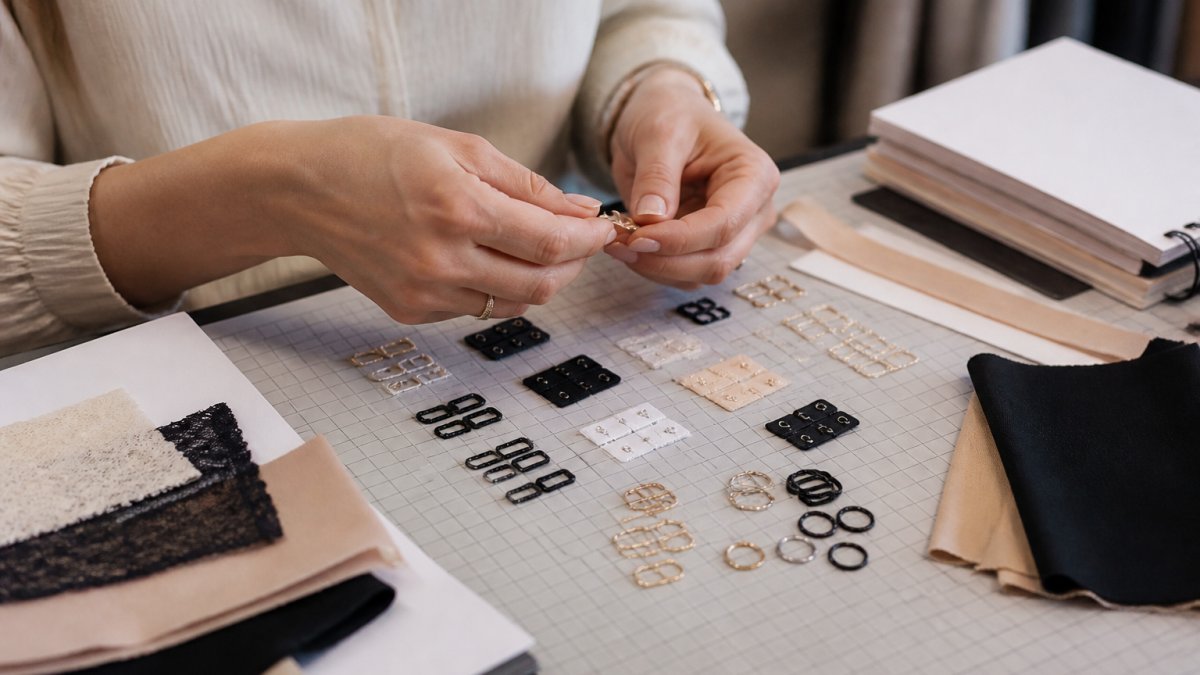
Build a sample kit that covers the range you are considering: two sizes either side of your target, every finish you might use, and the matching casing or elastic. Then run a wear trial. Sew the hardware into a garment, wear it, wash it, and inspect it.
A common mistake is treating samples as a formality and rushing to bulk. Learn how to avoid garment component recalls by catching durability and safety failures before production.
A Supplier Evaluation Checklist for Hardware and Trims
Supplier evaluation is the step small brands skip when they are in a hurry to launch. But a generic checklist will not tell you whether a supplier can actually deliver a 24 gauge underwire that glides through casing or a dyeable hook that matches your swimwear line. Use this hardware-specific checklist and score each supplier honestly:
- Confirms which product categories they specialise in (lingerie, swimwear, outdoor, etc.)
- States country of origin for each component
- Provides independent test documentation (e.g., Oeko-Tex, REACH) not just a claim
- Names the standards the hardware meets (nickel release, lead content, corrosion resistance)
- Confirms lead time for stock and for repeat orders, with a written estimate
- Explains minimum order quantity per size, colour, and finish
- Sends samples before bulk commitment, with a clear sample cost and turnaround
- Has a named contact who answers technical questions about gauge, dimensions, and compatibility
- Describes what happens if an order fails inspection (replacement, refund, or credit)
- Can scale with you as volumes grow, without changing suppliers
Score each line from 1 to 5 and total it. Anything below 35 out of 50 is a supplier who will cost you time later. Use the checklist to build a side-by-side comparison of each potential supplier, recording minimum order quantity, sample cost, lead time, quality documentation and backup capacity.
Testing Hardware Durability, Compatibility and Skin Safety
Durability testing answers one question: does the hardware survive the garment's real life? For swimwear that means salt water, chlorine and UV. For outdoor apparel it means abrasion and repeated tension.
Hook - White Nylon Coated Steel - Dyeable (8 - 25mm) Made in France →
Run these checks on every sample batch:
- Cycle test the closure 50 times and inspect for distortion.
- Load test straps and rings at the tension the garment will see.
- Wash test the assembled garment and check for corrosion, coating loss or colour bleed.
- Skin contact review confirms the component is nickel-free and lead-free where it touches skin.
Compatibility matters as much as strength. Wire gauge must suit the casing width. Slider width must match strap elastic width. A 10mm casing will not take a wire it was not made for, and forcing it shortens garment life.
Skin safety is where documentation earns its place. Read a focused look at whether skin-safe metal components are worth the cost for your products. For compliance guidance on REACH-compliant components to verify safety and regulatory fit, see our buyer's guide.
Landed Cost and Total Cost of Ownership on Hardware
Unit cost is the number on the quote. Landed cost is what you actually pay, and it includes freight, duties, taxes, currency movement, and the labour spent chasing a late delivery.
But to compare suppliers fairly, you need to break down the true cost per finished garment. Start with the quoted unit price, then add:
- Freight and shipping: For small hardware orders, freight can be a significant percentage of the total. Ask for Incoterms (FOB, CIF, DDP) and calculate the per-unit freight cost.
- Duties and taxes: Hardware made in Europe may attract different duty rates than hardware from Asia. Check the HS code and applicable tariffs for your destination.
- Tooling and setup fees: Custom dies, engraved logos, or bespoke finishes often carry one-time tooling charges. Amortise these over your expected production volume.
- Sample costs: Include the cost of samples and any testing you pay for. These are part of your development budget.
- Packaging and labelling: Some suppliers charge extra for individual bagging or custom labels. Confirm what is included.
- Defect and rework costs: A batch with a 2% defect rate may require sorting, replacement, or rework. Estimate the labour and delay costs.
- Inventory carrying cost: Ordering more than you need to hit a minimum can tie up cash and risk obsolescence.
- Reorder costs: If a supplier’s lead time is long, you may need to place larger, less frequent orders, increasing carrying costs.
Total cost of ownership adds the failures: the batch that corroded after ten washes, the closure that failed in wear testing after bulk arrived, the rework run that ate a season’s margin. Small brands feel these costs disproportionately because there is no second product line to absorb them.
Compare suppliers on landed cost per finished garment, not unit price. Ask for freight terms, confirm who pays duties, and calculate the cost per finished garment rather than per component.
Building Your First Hardware Order With Allied Trimmings
A first hardware order should be small, complete and documented. Start with the components you cannot substitute: the closure, the adjusters, the rings and the support structure. Get those right before you add decorative trims.
We supply European-made, jewellery-quality components.
Here is how we would sequence a first order:
- Send us your hardware bill of materials with sizes and finishes.
- Request samples of each component and test them on your fabric.
- Confirm minimums and lead time for your size curve.
- Place a bulk order sized to your first production run.
- Reorder against the same specification so nothing drifts.
If you work through a contract manufacturer, tell us early. We can align the specification and documentation so your factory receives what your design intended.
Frequently Asked Questions
Where can small apparel brands source garment hardware?
Look for trim specialists rather than general fabric wholesalers. A specialist carries the full component set for your category, for example bra hooks, sliders, underwire, casing and strap elastic for lingerie and swimwear, and can tell you the material, finish and certification behind each item. Allied Trimmings has supplied European-made trimmings since 1981, with REACH and GPSR-ready components, Oeko-Tex 100 certified sliders and rings, and 100% lead-free and nickel-free claims stated on the product listings.
Can small apparel brands order hardware in low minimum quantities?
Ask directly. Garment hardware minimum order quantity varies by component and finish: a dyeable nylon-coated hook at 1.00 per unit is stocked differently from a silver-plated ring at 3.00. Most suppliers publish bulk packaging and per-unit pricing rather than a fixed MOQ, so confirm the smallest order they will accept, whether colour or plating changes raise it, and whether in-stock items ship without a production run. Get that in writing before you build a costing sheet around it.
How do I check the quality and durability of garment hardware?
Order apparel hardware samples and test them the way the garment will be worn. Wash and dry a sample strap assembly, expose it to salt water and UV if the line is swim or outdoor, and check for plating wear, corrosion, burrs and sharp edges. For load-bearing parts, note the stated breaking strength and test in your own application: the ladder lock lists 30 kg for the 3/4 inch size and 50 kg for the 1 inch size as reference figures only. Confirm the supplier's testing is independent, not self-declared.
What compliance requirements should apparel hardware meet?
In the EU, hardware should be REACH compliant and ready for GPSR obligations, and skin-contact components should be nickel-free and lead-free. Ask for the certification behind the claim, such as Oeko-Tex 100, and for the country of origin. Allied Trimmings lists French-made hooks, sliders, underwire, clasps and rings with Oeko-Tex 100 certification and 100% lead-free and nickel-free statements, which gives you documentation to pass up your supply chain rather than a verbal assurance.
How can I compare hardware supplier quotes fairly?
Compare landed cost, not unit price. Add freight, duties, sampling fees, payment charges and the cost of rejects to the per-unit figure, then divide by the units that actually pass quality control. A 1.00 hook that arrives on time and passes inspection can beat a cheaper one that triggers a reorder. Run the same supplier evaluation checklist across every quote: MOQ, sample cost, lead time, certification, and what happens when a rush order lands.
The gap between a launch that runs smoothly and one that stalls is usually decided before the first bulk order, in the specification, the samples and the supplier questions you asked. Allied Trimmings has supplied European-made, REACH and GPSR ready trims since 1981, with independently tested, skin-safe components, bulk packing that suits small runs, and a team that answers technical questions directly. Get started with Allied Trimmings and build a hardware order your production team can repeat.


