


Last Updated: November 14, 2026
Quick Summary
Integrate hardware suppliers with contract manufacturers by writing down who owns each decision before any order, then using a shared one-page specification sheet that both sides sign. Run a structured onboarding over 90 days, approve physical production samples, and link each approval record to the batch so incoming inspection can match parts to what was approved.
- Integration failures usually trace back to unclear ownership, where each side assumes the other checks compliance.
- Keep each component's specification sheet to one page, covering material, finish, dimensions, strength and compliance standards.
- Split onboarding into three phases: documentation, sample validation, then a first production run with a measured baseline.
- Test rush-order responsiveness with a small expedited request before relying on the supplier during a crisis.
- Store approved sample photos, test reports and sign-off dates in a shared digital system tied to batch numbers.
Table of Contents
- Why Hardware Integration Breaks Down Between Suppliers and Manufacturers
- Defining Who Owns What: Sourcing Responsibilities in Contract Manufacturing
- Building a Hardware Specification Sheet Template That Both Sides Can Use
- Supplier Onboarding Checklist: Getting Hardware Partners Live Without Delays
- Production Sample Approval Process: Locking Down Hardware Before Bulk Runs
- Garment Hardware Quality Control: Testing for Skin Safety, Durability and Finish
- Planning Your First Integrated Hardware Order With Allied Trimmings
- Frequently Asked Questions
Hardware suppliers and contract manufacturers often fail to connect smoothly, and the cost usually lands on the production floor. Lead times slip, specifications drift and a batch of fasteners arrives that nobody approved. Integration problems between hardware suppliers and contract manufacturers often start long before the first bulk order ships. Deloitte Insights 2026 Manufacturing Industry Outlook notes that manufacturers continue to invest in smart manufacturing to improve competitiveness, agility and resilience, which raises the stakes on how suppliers and manufacturers coordinate.
Why Hardware Integration Breaks Down Between Suppliers and Manufacturers
Most integration failures trace back to unclear ownership. The supplier assumes the manufacturer will check compliance documents. The manufacturer assumes the supplier has already tested the component against the target market's rules. Neither side checks.
Outsourcing is growing fast. Thomasnet Top 10 Contract Manufacturing Suppliers 2026 reports a global contract manufacturing market valued at $831.99 billion in 2026, driven by outsourcing and demand for flexibility. More volume means more handoffs, and every handoff is a place where a component can slip through unverified.
Defining Who Owns What: Sourcing Responsibilities in Contract Manufacturing
Before any order, write down who owns each decision. Sourcing the hardware, approving the sample, testing for skin safety, and holding compliance records are separate tasks, and they often belong to different people.
A practical split looks like this:
- Brand or designer: sets the specification and approves final samples
- Contract manufacturer: orders components, runs incoming inspection and controls assembly
- Hardware supplier: provides test documentation, batch traceability and lead-time commitments
When one of these owners is missing, the gap usually shows up as a recall or a late shipment. For a deeper look at how sourcing roles fit the wider hardware supply chain, see our guide to garment hardware supply chain best practices.
Building a Hardware Specification Sheet Template That Both Sides Can Use
A specification sheet turns vague expectations into checkable requirements. Keep it to one page per component. Include material, finish, dimensions, load or pull-strength requirements, colour matching reference, and the compliance standards the component must meet.
For skin-contact items, add the test reports required and the acceptable tolerance for finish. A corset busk or swimwear slider that passes on paper but scratches skin in wear fails in practice, so the sheet should name the wear test, not just the material. The sheet works best when both the designer and the manufacturer sign it before sampling starts.
Supplier Onboarding Checklist: Getting Hardware Partners Live Without Delays
Onboarding is where most delays hide, and a flat checklist does not prevent them. The first 90 days set the pattern for the entire relationship, so structure onboarding in three phases with clear exit criteria for each.
Days 1-30: Documentation and system alignment. Before any purchase order, confirm the supplier's test reports cover your target market rules, agree minimum order quantities and rush-order terms in writing, and set up batch numbering so every delivery can be traced to a test record. Share the specification sheet and get written acknowledgement. This is also the window to exchange technical data formats: ask whether the supplier can provide certificates of analysis (CoA) and test reports as structured CSV or XML rather than scanned PDFs, and confirm whether they can accept your purchase orders via EDI (electronic data interchange) or a supplier portal. A supplier that still runs on email and paper will slow every future order.
Days 31-60: Sample validation and process mapping. Order a pre-production sample set and log the approval date. While samples are in review, map the physical handoff: who receives incoming components at the contract manufacturer, how incoming inspection is recorded, and where non-conforming parts are quarantined. Ask the supplier for their standard lead time and their stated capacity buffer.
Days 61-90: First production run and performance baseline. Release a small bulk order and measure three things: on-time delivery against the promised date, first-pass yield at incoming inspection, and documentation accuracy (does the batch paperwork match the physical batch?). Record these as your baseline for the performance management system you will use going forward. If the supplier misses the baseline, the 90-day review is the moment to correct it, not after a full season of orders.
Watch out: a supplier that will not commit to a rush order during onboarding will not commit during a crisis either, so test rush responsiveness with a small expedited request before you depend on it.
If you need help finding a reliable partner in the first place, read how to find reliable garment trim suppliers before you start the checklist.
The three onboarding phases, with what each one must settle before the next begins.
| Phase | Key actions | Exit check |
|---|---|---|
| Days 1-30 | Confirm test reports, agree rush terms, set batch numbering | Specification sheet acknowledged in writing |
| Days 31-60 | Order pre-production samples, map incoming handoff | Sample approval date logged |
| Days 61-90 | Release small bulk order, measure delivery and yield | Performance baseline recorded |
Production Sample Approval Process: Locking Down Hardware Before Bulk Runs
Approve the sample, not the photo. To see which mistakes lead to recalls, read how to avoid garment component recalls. Physical samples show finish, weight and how a fastener behaves on the garment. A production manager and a garment technician should examine samples together on the actual fabric, checking that snap fasteners and zipper pulls hold, don't corrode after a salt-water test, and don't scratch. Record the approval with a signed date and the batch reference. Any later change to the component needs a new sample approval, not a verbal okay on the factory floor.
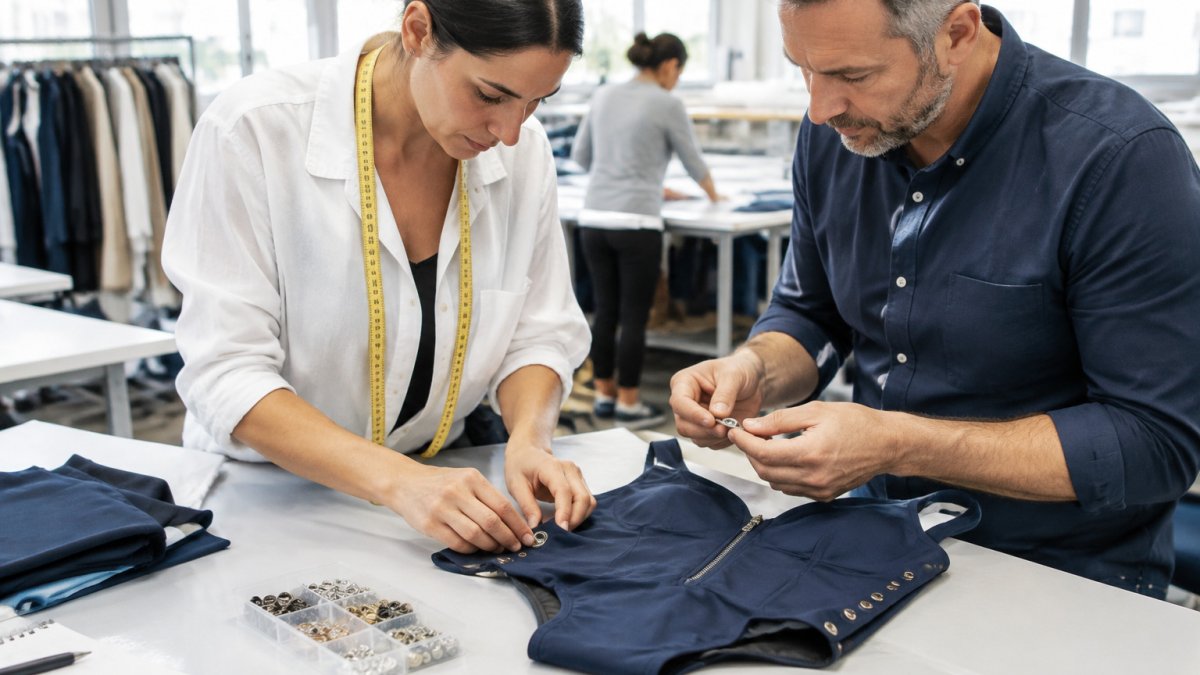
The part most guides miss is what happens to the approval record after signing. A signed paper sample sheet that lives in a folder does not prevent a drift in production. The approval record needs to be digital and linked to the batch: store the approved sample's photos, test reports and sign-off date in a shared system the contract manufacturer can access at incoming inspection. If your supplier and manufacturer use different ERP or PLM systems, agree on a single reference format (for example, a component ID plus revision number) that both sides use on every document. Without that link, a well-run sample approval still fails at scale because the factory floor cannot match the physical part to the approved record.
There is also a risk angle to sample approval that integration guides rarely mention: over-reliance on a single integrated partner. If one supplier provides the component, the test documentation and the batch traceability, a single quality failure can halt production with no alternate source. During sample approval, ask the supplier whether they have a qualified second production site or a documented backup for critical finishes.
Finally, treat the approved sample as a living document. Set a review cadence (annually, or whenever the supplier changes a sub-supplier or plating chemistry) and require a new sample approval at each review. A component that passed two years ago may not match today's production if the supplier has changed its own supply chain.
Garment Hardware Quality Control: Testing for Skin Safety, Durability and Finish
Quality control should test three things: skin safety, durability and finish. For skin safety, require documented migration testing for nickel and other restricted substances. For durability, test pull strength and fatigue after repeated washing. For finish, check colour and plating against the approved sample under the same lighting each time.
Compliance requirements are changing. Before you finalise your testing plan, check the current general product safety rules that apply to your market, and ask your supplier to confirm how their documentation maps to them. EU General Product Safety Regulation guidance sets out the obligations manufacturers and suppliers carry for consumer products sold in the EU.
Planning Your First Integrated Hardware Order With Allied Trimmings
Your first order sets the pattern for every order after it. Start small enough to catch problems, but large enough that the supplier takes the job seriously. Send the specification sheet, confirm the onboarding checklist is complete, and approve the sample before releasing the bulk run.
Pricing depends on quantity, component type, finish and delivery dates, so ask for a quote rather than working from estimates. For current pricing and to start a conversation about your order, visit our hardware options page or contact the Allied Trimmings team directly.
Integration works when the supplier, the manufacturer and the brand agree on who owns each decision before production starts. Allied Trimmings has spent more than four decades supplying European-made, independently tested trimmings for skin-contact and outdoor apparel, and we build our order process around the same checkpoints described above. Ask us about our test documentation and rush-order terms before your next production run.
Frequently Asked Questions
How do you integrate a hardware supplier with a contract manufacturer?
Start by sharing a complete hardware specification sheet with both the supplier and the contract manufacturer, covering dimensions, materials, finish, load requirements, and compliance documents such as REACH and GPSR declarations. Agree on who places orders, who approves samples, and how lead times are tracked. Then run a pilot with one style before moving to bulk production. Pricing depends on quantity, dates, and delivery, so request a current quote from Allied Trimmings directly rather than relying on estimates.
What information should a contract manufacturer receive from a hardware supplier?
A contract manufacturer needs the part number, material composition, finish, dimensions, tolerance, attachment method, and packaging details for each hardware item. It also needs test reports showing skin-safety and chemical compliance, a sample for fit and attachment testing, and clear minimum order quantities and lead times. Ask the supplier to confirm which certificates apply to each component, so the factory can keep them on file for buyer audits.
How can brands prevent hardware delays during garment production?
Most delays come from late sample approvals and unclear order ownership. Confirm lead times for each hardware item before the garment patterns are finalised, and build buffer time into the production calendar. Keep a shared tracker that both the supplier and the contract manufacturer can update. Brands sourcing from Allied Trimmings can ask for a current stock and lead-time confirmation as part of the quote process.
What quality checks should be used for garment hardware before bulk production?
Test a pre-production sample for pull strength, corrosion or tarnish under humidity, finish wear after repeated friction, and attachment to the actual fabric. For intimate and swimwear lines, confirm skin-safety test results and REACH compliance for each component. For outdoor garments, add saltwater and UV exposure checks. Record the results against the approved sample so the factory has a clear reference during bulk production.


